Talking TIFs
TIF surplus is a growing part of the Chicago Public Schools' budget. But sweeping TIF districts pulls money from neighborhood construction, including schools. And the big TIF surpluses won't last forever.
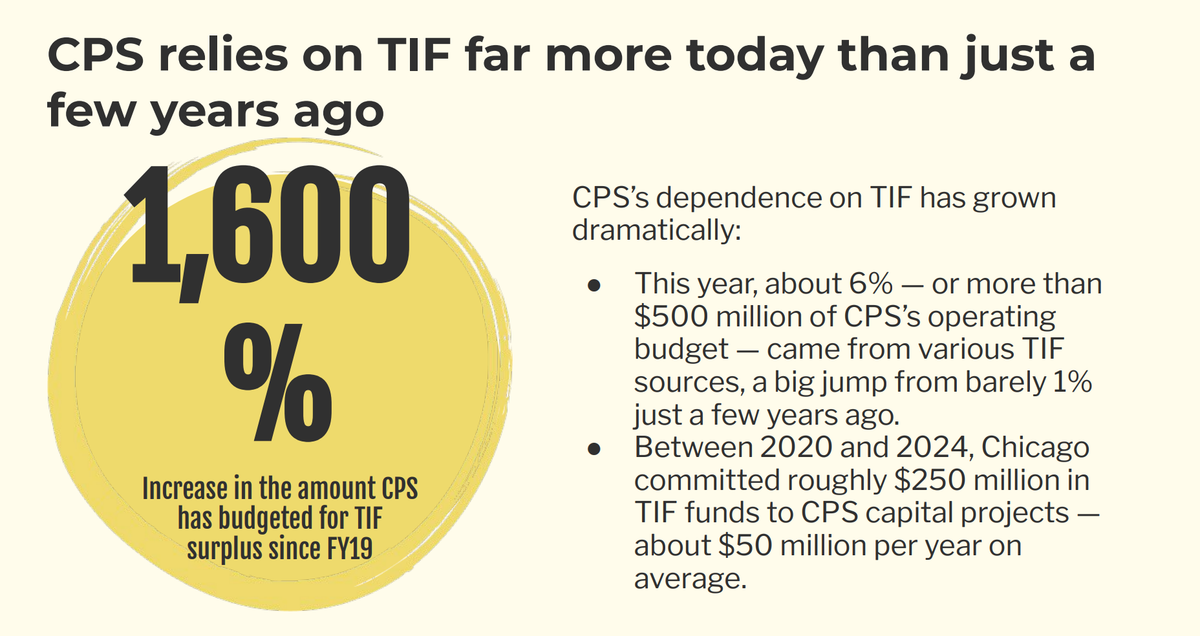
Chicago's City Council and Mayor Brandon Johnson are still wrangling over the 2026 budget, which must be passed by the end of the month. But one element of that budget is not in serious dispute: the $1 billion TIF surplus, which will keep the Chicago Public Schools' budget stable through the school year.
"Our proposal does not touch the TIF sweep," said Alderwoman Nicole Lee (11), who teamed up with Alderman Scott Waugespack (32) on Tuesday to present an alternative to the mayor's budget to the City Council Finance Committee. The committee voted to advance the proposal to the full council, but Johnson immediately condemned the plan, calling it "immoral" and "not feasible," because it relies on stepped-up efforts to collect debts like unpaid water bills and tickets. It would take 34 council votes to override a mayoral veto.
The open question about how the budget stalemate might affect schools is: what happens if a budget is not passed by the Dec. 31 deadline? Could Chicago face a municipal government shutdown? Joe Ferguson, president of the government watchdog Civic Federation, insisted the concern was groundless. "We are going to have a budget, and it's going to involve the largest TIF sweep in history, which means the largest transfer of money to CPS in history," he said.
Questions from parents and other attendees revealed broad confusion about how TIFs work and a lack of understanding of the difference between TIF district funds, that can pay for school construction projects for schools within the district, and TIF surplus, which the city can declare to send itself money. When the city declares a TIF surplus, by law, it must send about half of the money to the Chicago Public Schools. When CPS receives TIF surplus funds, it can use that money for any purpose, not just school construction, and the funds can be used citywide.
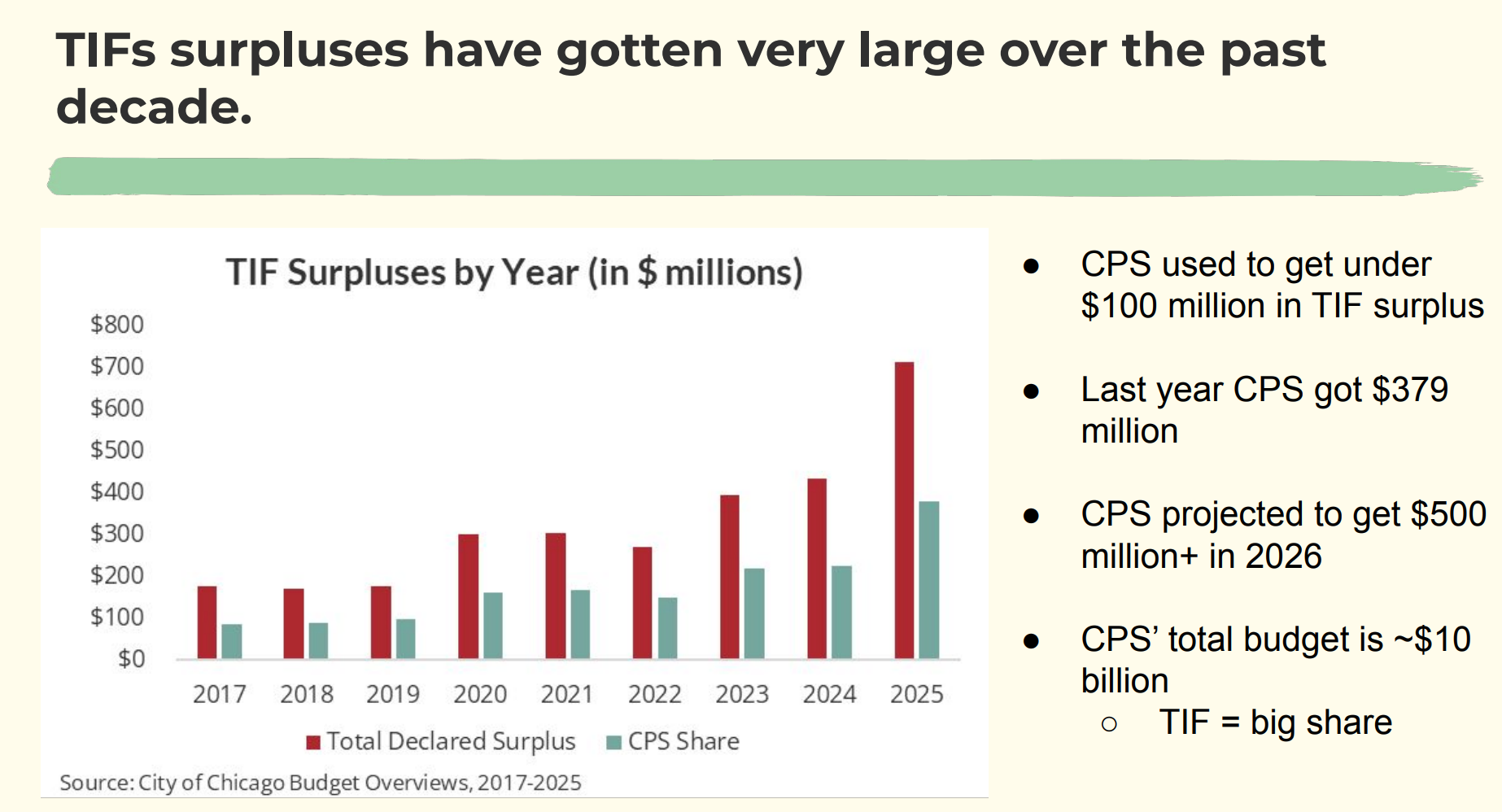
Within the last decade, the amount of money in declared TIF surplus has grown, with a big leap under Mayor Johnson.
But the good times won't last forever. Most of today's TIF districts will expire starting in the early 2030s. While this process releases funds back to schools, parks, and libraries, it will eventually make it more difficult for CPS to raise taxes. CPS is subject to a law that limits how much it can raise taxes each year, but funds released from TIFs–whether by surplus or when the TIF expires– are not subject to those limits. "TIF surpluses and expiring TIFs actually allow CPS to partially evade the tax caps that are in place now," said Danny Vesecky, policy and research associate at the Civic Federation. When TIF surpluses and expirations come to an end, the school district will lose this loophole to increase taxes beyond the annual limit.
This recap barely scratches the surface of understanding TIFS. Panel moderator Nell Salzman described TIFs as "one of the most powerful, and, I would say, least understood forces shaping our city today." To learn more, you can view last night's full set of presentation slides in English, Spanish, or Mandarin Chinese. You can also explore a map of Chicago's TIF districts with projects.
InFocus: Destiny Singleton
Honorary student board member Destiny Singleton cares deeply about student mental health. In October, she spoke movingly about the emotional impact stepped-up immigration enforcement has had on CPS students, regardless of their personal risk. Recently accepted to Stanford, she plans to major in psychology. Her long-term goal is to become a psychiatrist and work with young teens.
Board Rule recently spoke with Singleton about her top issues and how she juggles her board service with her busy senior year in the International Baccalaureate program at Ogden International High School. This interview has been edited for length and clarity.
Q. What is it like sharing a student's perspective with the board?
A. I love getting to talk with everyone and just learning more about the process of being on a board and learning about all the diverse issues in CPS, because I'm limited to my school and my perspective. Seeing that opened up by so many other different perspectives and backgrounds, and histories in their schools has been phenomenal. And I really love just sitting there and taking it all in. Sure, I'm the voice, but it's also really important for me to hear and not just speak.
Q. How have you been received by your fellow board members?
A. They're so kind. They have been so welcoming and wanting to get to know me. They reach out and invite me to things.
Q. What are your priorities for your term in office? What do you hope to accomplish?
A. The first thing I really want to get sorted out is mental health issues among students. I have seen how damaging school can be for students' mental health. Having the right services at school and at home to prioritize their mental health isn't equal, and I want to see that sorted out. For example, at our last roundtable with other students who applied for this role, they didn't know that CPS has free mental health therapy. But [at] my school, they prioritize it. Our school counselors make it known that we have this option. I'm just thinking about the thousands of kids who don't know what's out there for them.
Q. Let's go a little deeper into your thoughts on student mental health. As you said, expanding services by providing teletherapy is an opportunity. Are there other things that you would like to see happening in more schools to support students?
A. I would say a lot more counselors and people who are specifically dedicated to helping students with their mental health inside the buildings. Counselors either can't hold the capacity of all the students in their building, or they're strictly dedicated to academics, and you can't talk to them. You can't just go in their office and talk about your day and let all those feelings out.
Q. State law now offers up to five mental health days for students. But, and I don't think this is unique to CPS, there hasn't been a way to accommodate that in attendance policy or in school accountability for attendance. What are your thoughts about how to make mental health days more of a reality?
A. I've seen that personally, I've taken a lot of days off for college visits and being at the board, and those were gratefully excused, but I still need mental health days. Just because I'm taking those days off doesn't mean that I'm not working and I'm not doing something actively. And my school [has] kind of a strict policy. If we miss more than four days, I think, of the quarter, they can take away our prom. It shouldn't be my mental health versus prom.
Q. What do you want adults who care a lot about CPS to know?
A. Students' voices are here to stay, and they're not to be bulldozed over. We're the ones who have to be here day to day. We have to sit in classes and under these policies that directly affect us. Even people you don't expect to bulldoze over our voices do. It's important for you to listen to us and not take us lightly.
Comments ()