Budget 101: Where CPS Gets $
CPS relies on three main revenue sources and has few levers with which to raise more money from them.
Later this month, the Chicago Public Schools will launch its second annual round of “community roundtables” about its operating budget for fiscal year 2027. Building any government budget is complicated, and the CPS budget is no exception.
Before the CPS roundtables get going, Board Rule will walk readers through three things:
- the building blocks of the budget;
- why CPS budget categories make it hard to answer common-sense questions about spending, and
- how Chicago Public Schools might close the gap between the revenue it has and the money it needs and wants to spend.
These posts are your guide to understanding the budget process. For the numbers, we’ll look at the FY 2026 budget.
Before we start tackling the budget’s building blocks, let’s take a quick tour of how the budget gets built.
A 30,000-Foot View of the CPS Budget
For starters, CPS actually creates three separate budgets. In addition to setting a balanced operating budget for each new fiscal year, CPS must also budget for debt service and create a capital budget to address the needs of its buildings. First and foremost, CPS must meet its debt obligations, but there are ways to refinance debt to put off repayment longer. Refinancing can help close a current budget gap, but make it harder to balance future budgets. CPS took advantage of this last year and will likely be unable to do more this year. According to the 2026 CPS Budget Book, the capital budget is primarily funded by bonds, and most of those bonds are repaid with funds that come to CPS from the state.
It’s also important to remember that the school district ended its use of student-based budgeting with the FY 2025 operating budget. Previously, CPS allocated a standard amount of money per student enrolled, then added funds based on each school’s characteristics and needs. Principals had much more control over their money, but the system favored larger schools.
This changed in fiscal years 2025 and 2026, when schools received a set of “foundational resources:” a principal, an assistant principal, a clerk, at least one counselor and a set of core classroom and “holistic” teachers (such as art, music, gym teachers). Based on need, CPS allocates additional teachers and other funds, including flexible funds principals can choose how to spend.
The school district now appears ready to tinker with those foundational resources, given that up to 120 assistant principals in small schools have been told their jobs will be eliminated as part of closing the budget gap.
The Budgeting Process
In Step 1, principals receive their school-level budgets. They then make decisions about changing staffing or programs to make school spending match the positions and dollars they will receive in the coming year. In schools with Local School Councils, LSC members vote on the budget. How much the principal works with the LSC to determine the final budget for approval varies widely from school to school.
This is the moment, usually sometime in April or May, when parents and LSC members of schools facing cuts sound the alarm that their schools are losing staff: teachers, teacher aides (special education classroom assistants, or SECAs, and/or teacher assistants), cafeteria workers. Schools have an opportunity to appeal their budgets and sometimes win back positions, especially special education teachers and SECAs.
In the second step, CPS decides how to divide up the remainder of the revenue among central office departments, vendors, networks, and budgets for the Chief Education Office and the Chief Operating Office, which send citywide services and people to schools. That includes clinicians, psychologists, social workers and special education staff.
Note that those people and services that go to schools from the CEdO or the COO are not tracked on school-level budgets, making it hard to figure out the full amount of money schools are receiving and how it’s getting to them.
It’s this second step, which used to be completed by June 30, but has recently begun to stretch into July and August, that brings up arguments about how much TIF money to surplus and whether the school district should pay into the city pension fund that includes non-teaching CPS staff. LSC members tell Board Rule that as central budget negotiations have dragged into the summer, they are seeing more positions in schools funded through the central office, and more school budgets receiving multiple rounds of revision beyond the deadline for final approval by the LSC. This suggests that the delayed budgets have the side effect of further undermining LSC authority.
Building Block 1: Revenue
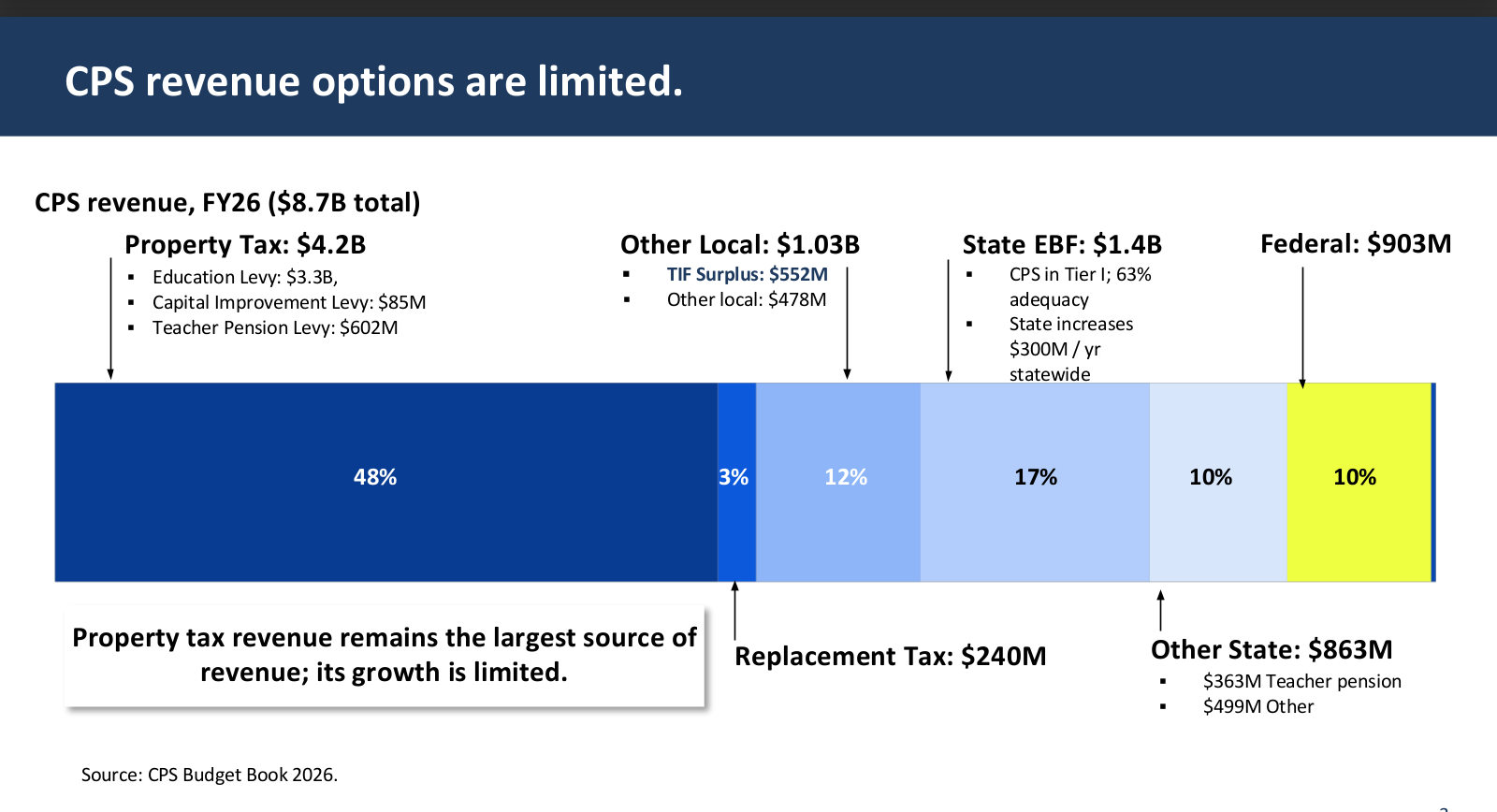
CPS gets its money from three main sources: property taxes, state funds, and federal education funds. A fourth source--TIF surplus--"is not a magic pot of money; it's just property tax dollars," noted Daniel Vesecky, a policy and research associate at the Civic Federation, a nonpartisan government watchdog.
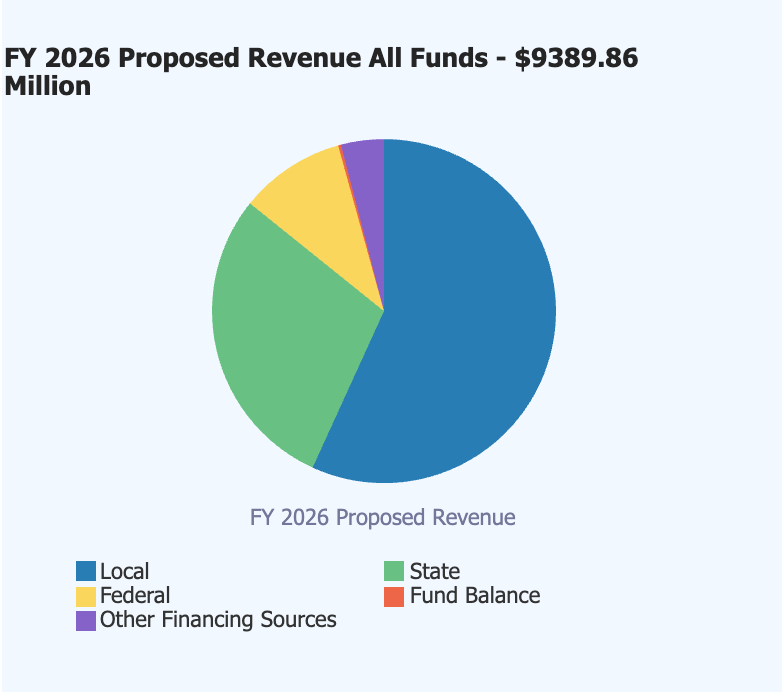
Property taxes make up the largest share. In 2026, property taxes made up most of the 57% of the local revenue that came to the Chicago school district.
Chicago’s ability to raise property taxes is fairly limited; due to a state law, it can only raise its property tax levy each year by 5% or the rate of inflation, whichever is less. The Chicago Board of Education has raised its levy to the maximum allowed for more than 20 years, Acting Chief Financial Officer Wally Stock told board members in December 2025.
State money. In 2026, state funds made up 29% of total revenue to CPS. For many decades, Illinois was one of the nation’s worst states for funding K-12 schools. But in 2017, Illinois created a new formula to send money for schools. It set a definition for adequate school funding and began directing new money coming into the formula toward the schools farthest from adequacy.
When the new formula was created, the state set a goal to get all school districts adequately funded by 2027. Illinois has funded the formula pretty consistently for nearly a decade, and as of 2025 the state ranked 18th nationally in state spending per student. Despite this progress, Illinois is not expected to get all school districts to adequacy until 2038. This is why many progressives, including the Chicago Teachers Union, are calling on Illinois to increase the amount of money it gives schools beyond the $350 million a year that has been standard.
Federal money. Only about 10% of the revenue Chicago Public Schools receives comes from the federal government, and it is usually earmarked for specific purposes, like teacher professional development, or intended to benefit specific kinds of students, like Title I funds to benefit students from low-income families. The Trump administration has made many attempts to cut or disrupt federal funding to schools.
Of these three revenue sources, the state is the likeliest place to look for more money. The commitment made in 2017 has yet to be fulfilled. But the federal government’s tightening of social safety nets like SNAP and Medicaid is putting pressure on states to spend money to pick up the slack.
TIF surplus. There’s one more revenue source both the city and the school district have turned to in recent years to solve their budget problems: TIF, or tax increment financing. The Civic Federation explains TIFs and the surplus funds they have been generating in great detail, but for this discussion of revenue going to CPS, you only need to know three things:
- The City of Chicago decides how much TIF money to surplus.
- By law, CPS receives about half of whatever TIF funds are surplussed; the city receives about a quarter of the total funds.
- The City of Chicago won’t decide how much TIF to surplus until months after the school board passes a budget. This leaves CPS guessing how much TIF money it will receive. While all government budgets are based on revenue assumptions that could change during the fiscal year, there's an added level of uncertainty around TIF surplus money.
So there you have it–the revenue side of the CPS budget. The takeaway: CPS relies on a handful of funding sources and has few levers to raise additional money from them. Next week, we’ll look at the biggest cost drivers in CPS and show you why the way the school district sets up its budget categories makes some common questions hard to answer.
Comments ()