Candidate Filing Opens
On Monday, dozens of aspiring Chicago school board members filed their candidacy petitions. But can the current board do more than "govern by resolution"?
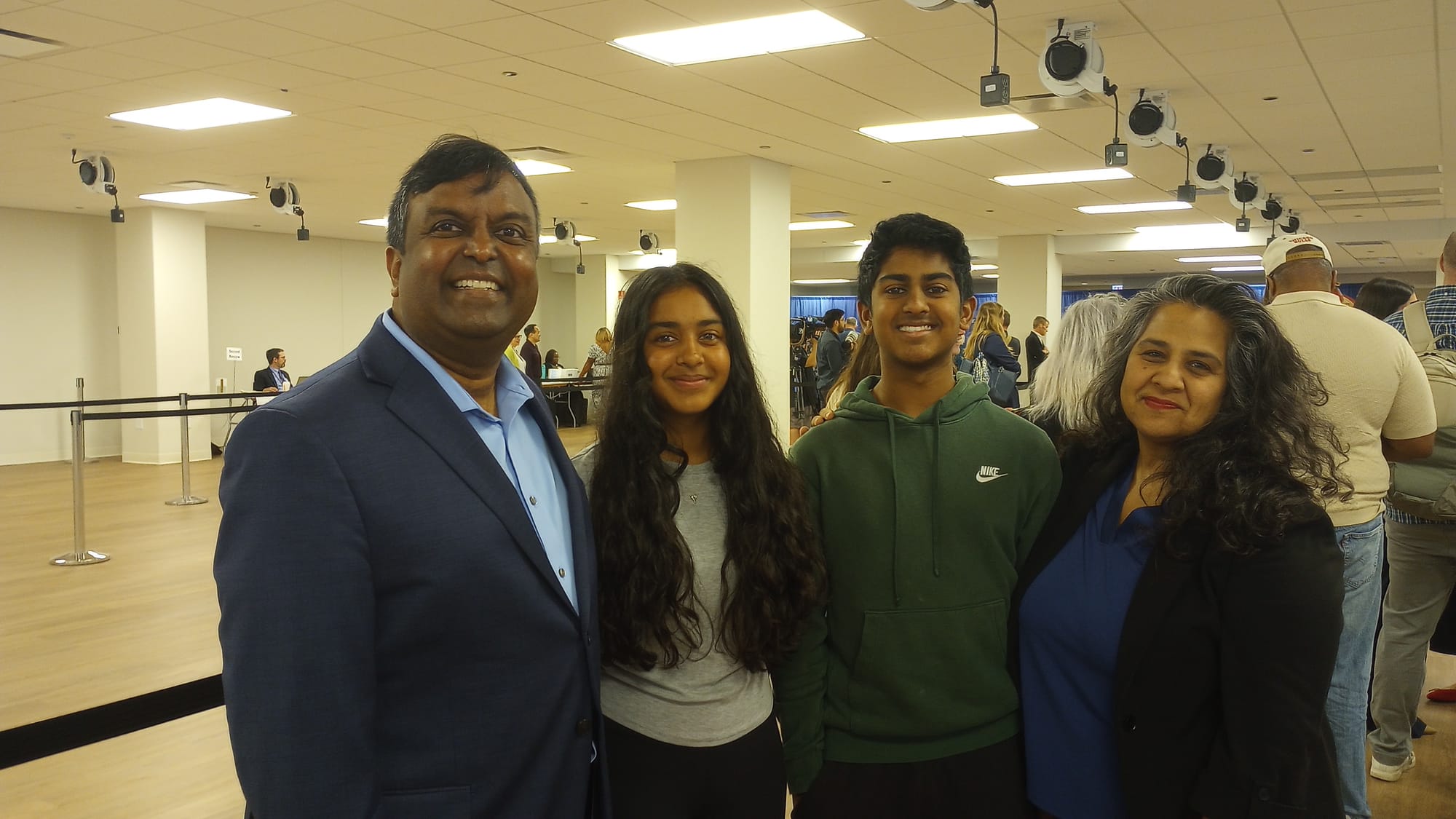
On Monday, first in line to file nominating petitions for school board was West Side trial lawyer Victor Henderson, who serves on the board of Urban Prep charter school. Henderson, who is running citywide for board president, stressed his commitment to a "culture change," saying, "We want the children to be front and center: their outcomes, their graduation rates, their opportunities to have their lives transformed."
Chicago tradition dictates that candidates who arrive by 9 a.m. on the first day of filing are entered in a lottery for a chance at the first spot on their ballot. We can expect another wave of candidates next week, on May 26, the last day to file. Those candidates will enter a lottery for the last spot in their ballot order. Candidates for board president had to collect a minimum of 2,500 signatures, up to 7,500. Candidates for district seats must collect a minimum of 500 signatures, to a maximum of 1500. That's half as many as last time, since the 10 districts of 2024 have now each been split in half, creating 20 districts.
The other declared presidential candidates were also lined up to file: Jessica Biggs, Jennifer Custer, and Sendhil Revuluri. Notably absent was Hilario Dominguez, the Chicago Teachers Union's political director, who is rumored to be gathering signatures. (The incumbent board president, Sean Harden, has announced he will not run for election.)
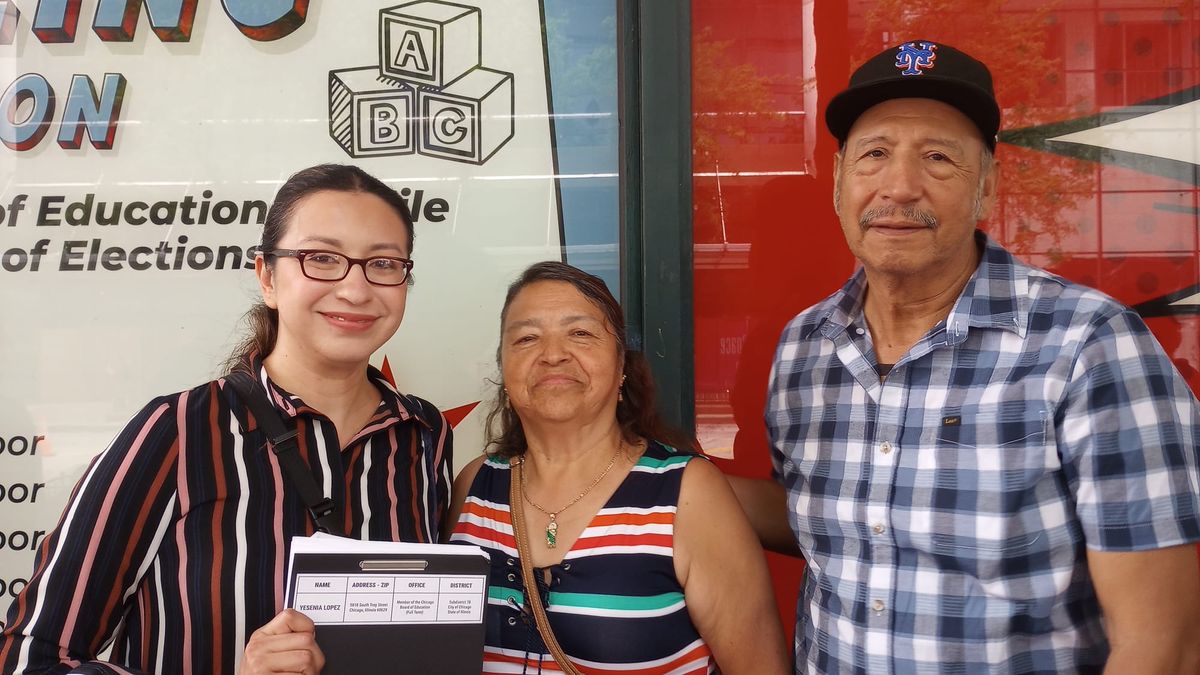
Board Rule spotted 16 of 19 incumbent board members filing paperwork today. (There is no incumbent in district 10B.) Board members Angel Gutierrez, Ángel Vélez, and Cydney Wallace did not file this morning but have been gathering signatures. UPDATE: Angel Gutierrez informed Board Rule he was present yesterday, 14th in line, and filed.
If you just can't get enough of yesterday's filing coverage, check out what ABC7, Chalkbeat Chicago, the Chicago Tribune (gift link), and WBEZ had to say. WBEZ has the best photos! Board Rule will have a few more photos for you tomorrow.
Board Talk: How to Lobby, How to Govern
Last Thursday, the board discussed a resolution sponsored by Anusha Thotakura (6A) that would encourage state lawmakers to explore "progressive revenue solutions." That means taxes designed to take more money from people and businesses that have more money to pay them, while having less financial impact on those with fewer resources. Money from those taxes would support schools all over the state.
Chalkbeat's coverage of the conversation last week framed it as part of the larger budget deliberation. That's true, and the discussion also revealed how the board is going about its work. The conversation begins at 3:17:52 on the video and lasts about 20 minutes. Here are some edited highlights.
Anusha Thotakura: I feel like we're exactly where we were this time last year, staring down a very serious deficit, and we have not made any progress to secure additional revenue from the state. Last year, we had to make incredibly difficult and drastic cuts to various programs affecting our students and our communities, including Safe Passage and custodial workers. And this year, our schools and our communities are bracing for even worse.
The only way that we can advocate for our students to get the funding that they deserve is for us to come together and show support for progressive revenue solutions at the state level, to fully fund the evidence-based funding model. We, as a school board and as a school district, do not have the taxing authority to secure the revenue that our students need. Although we have to pursue additional options from the city TIF dollars, we also need to support progressive revenue solutions, because we cannot get out of this hole by continuing to raise property taxes on our communities.
I appreciate the board members who have shared [an] interest in co-sponsoring this resolution. This resolution intentionally does not name specific proposals, but more so mentions a broad idea of needing progressive revenue solutions for our students and for families. And I want to thank every single board member who has been down to Springfield, and Dr. King, for going down to Springfield to advocate for additional school funding. But that's not enough in this final stretch; we have to do more.
Jitu Brown: If Chicago Public Schools, labor partners, the city of Chicago, community based organizations do not unite around demands for progressive revenue, it's [a] dereliction of duty. We have not done all we can, in the way that we can, to actually upset a system that is basically structurally inequitable. We have money to bail out football teams, but we don't have money to invest in children. And to me, that is a dereliction of duty.
Don't come up here talking about closing schools if you have not been leader enough, visionary enough, courageous enough to tell Springfield that the status quo will not work.
Jennifer Custer: I really appreciate Board Member Thotakura bringing this to a discussion, and it not just ending up on the agenda for a vote, not being able to discuss amongst ourselves. [Note: Last-minute changes to the agenda--both additions and subtractions--have been a continuing issue since this board was seated in January 2025.]
I've noticed over the last year and a half that we, as a board, like to govern by resolution, and we don't really leverage any of our other governing authority or governing power that we have. I don't have any issue with the spirit of the resolution. But I think as we grow into our governance...we have to direct the things we're trying to do into the appropriate venue.
I think the appropriate venue is not necessarily a resolution on the floor here, but part of our legislative agenda, which we were presented in January and never took a vote on. So we've never really directed the district, or anybody in the district, on what exactly we want to work on, and progressive revenue is not in that [January] presentation.
Michilla Blaise: I just want to co-sign what Board Member Brown said about unity and us coming together to talk to our partners in Springfield. Member Zaccor was just telling me that she campaigned on this two years ago, and here we are. But also, to our partners in Springfield, please understand we see you as partners. We're not going down there to attack you.
Ellen Rosenfeld: I just want to reiterate what board member Custer said. I also find this board governs by resolution more than any other board ever has, and resolutions really have little to no long-term implications. They're one time. They're ad hoc. I think they signal directives politically. It's like performative governance. So I would also love a legislative agenda, and love to work for policies that have long-term implications for the district.
Debby Pope: Obviously, resolutions are not the answer. Nobody is saying that resolutions are the answer. Resolutions are a way of expressing and conveying and communicating ideas and beliefs and positions. Of course, we have to be in Springfield. Of course, we have to examine various things. Of course, we have to fight for additional sources of revenue. That's why many of us were out there pushing for the millionaire's tax, which would have brought a real amount of revenue into our system. And we will continue to do that kind of advocacy.
So yes, resolutions are not the be-all and the end-all and the answer, and yes, we need to have a multi-layered, multi-faceted strategy, but we do need to do something, because we cannot balance our budget on the backs of students, on the backs of educators, and on the backs of our communities.
Yesenia Lopez: Thank you, Board Member, for taking the initiative and drafting this and circulating the language. ... I will also ask board members, whenever you're at Springfield, feel free to take some of the community leaders. I drove some of the mom leaders, and we were having these conversations with legislators.
Thotakura: I want to thank board members for their feedback. The only legal authority that we have as board members is to vote yes or no on items that come before us at public meetings. I don't have the authority to put our legislative agenda on the agenda. If that was within my authority, that's what I would have advocated for. I do agree with you, Board Members Rosenfeld and Custer, that that's ideal, but given that that's not what's in front of us, I've been advocating for this resolution to be put on the agenda for months. ... [The timing is] not great either, because, by the time we have our next board meeting, there's a couple of days left in session. But I'm hoping this allows us not to yell at state legislators. ... If people do have any specific feedback regarding language or framing, I invite those recommendations.
Brown: When we go down as board members again, just like if Chicago Teachers Union is going down, if SEIU is going down, if the City of Chicago is going down, there needs to be a united message. [Brown referenced the four bills now before the Illinois Senate, including the digital ad tax.] I think we should have a conversation about what is our agenda when we go, because if we're all going down there saying different things, then none of us are going down there really, because they don't feel pressure.
Analysis: From Resolution to Legislative Agenda
Bridget Lee of the Academy for Local Leadership provided these reflections on the board's discussion, the proposed resolution, and the question of whether a resolution or a legislative agenda is a better way to lobby state lawmakers.
CPS absolutely needs more adequate and equitable state funding, including full funding under Illinois' Evidence-Based Funding formula. I also appreciate the board naming the need for progressive revenue solutions. Chicago's students deserve a funding system that reflects the real cost of providing a high-quality education.
A resolution can be an important statement of values. But naming the need for progressive revenue and full funding is not the same thing as having a legislative strategy to secure them.
That strategy should spell out what the board is asking for, which revenue proposals it supports, who is responsible for engaging state leaders, what coalitions are being built, and how progress will be reported back to the public.
This is a common governance practice. School boards and districts across the country adopt public legislative priorities or advocacy agendas to guide their work with state leaders. LAUSD publishes an annual advocacy agenda and sponsors legislation through its Office of Government Relations. The Atlanta Board of Education publishes legislative priorities for the Georgia General Assembly and state education agencies. Here in Illinois, IASB identifies annual legislative priorities and provides advocacy tools for school board members.
This is a governance opportunity. As the board continues to grow into its role, it can model what strong public leadership looks like: moving from shared concern to clear priorities, coordinated advocacy, and transparent accountability.
The public does not need the board to simply say CPS needs more revenue. The public needs to understand how the board is using its authority, relationships, and public platform to help secure it.
The resolution can be a starting point. The next step should be a public legislative agenda.
Revuluri, who served as vice president on Mayor Lori Lightfoot's appointed board and is now running for board president, spoke both to governing by policy, not resolution, and discussed why having a legislative agenda matters for successful lobbying.
Governance by resolution becomes a lot more about the board's own feelings, and performing by saying things, not necessarily results for the district or for kids. If we have clear policy, then we actually have goals that set expectations for the district's leadership, and something that can be monitored. There can be actual accountability for whether we can get there or not.
The resolution [under discussion] last week was intended, it seems, to take the place of a legislative strategy. That's not something where the board is exercising its governance power on the district's leadership, but it is an important role for the board to advocate for the district's interests to other units of government. That's going to include sister agencies (like the park district), that's going to include the city, that's going to include the state--and the federal government at some point, we hope.
A legislative strategy is different from just continuing to state or scold. It's about having a clear sense of what we're trying to accomplish, finding common cause, and then collaborating to make it happen. I look forward to the board doing that. I hope it happens sooner rather than later.
Comments ()