Chicago School Board Prez Candidates on Special Education
Plus, school funding is based on property taxes, not enrollment. So let's stop telling scary stories about declining birth rates.
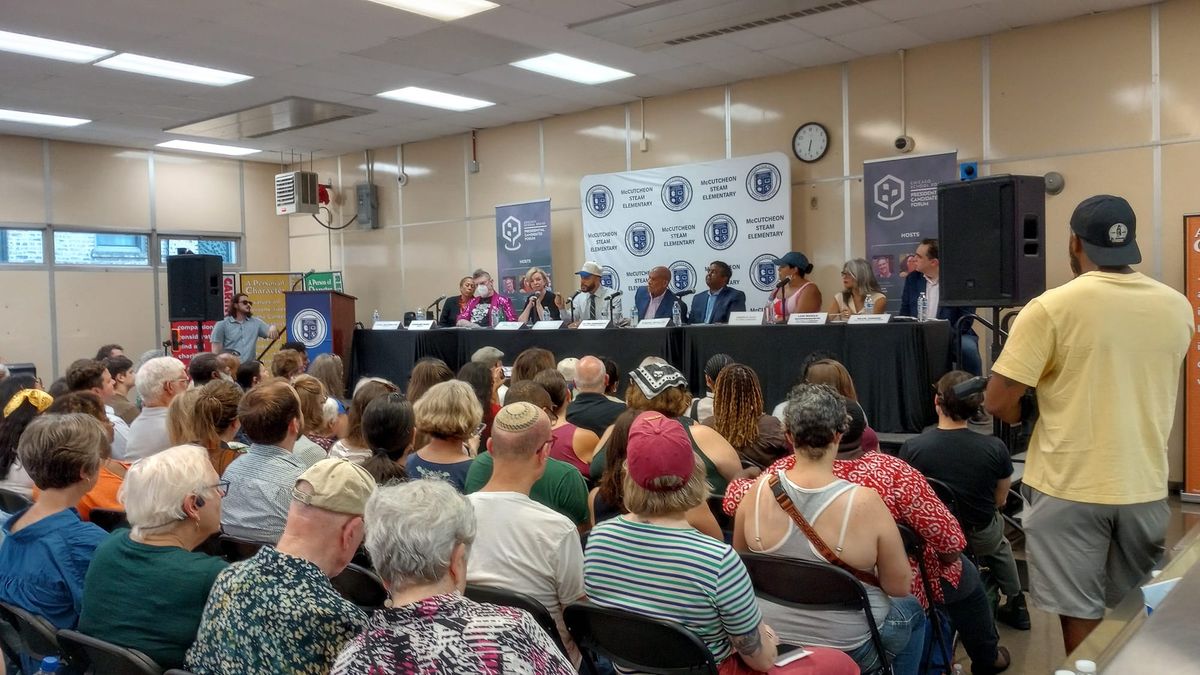
For folks who want to understand how the candidates running for seats on the Chicago Board of Education think about the board, its relationship with school district leadership, and its oversight role, perhaps no candidate questionnaire is more important than the one from disability rights organization Access Living.
The bad news first: a dozen candidates did not complete this questionnaire. Many candidates have told me they are overwhelmed by the number of candidate questionnaires being sent their way. But this subject is critical for board members and voters to understand.
According to Crain's Chicago Business, last school year, 84,000 CPS students with disabilities had an Individualized Education Plan (IEP) or 504 plan to support their learning. Historically, students with disabilities have far worse educational outcomes than their non-disabled peers. As WBEZ recently reported, special education costs have nearly doubled since 2019. Shortfalls in federal and state spending mean that Chicago Public Schools must use its core source of revenue--property taxes–to meet the growing demand for specialized educational services that meet the legal requirements to serve students with disabilities.
These numbers suggest that the district is staggering under an unfunded mandate while students with the greatest need still aren't set up for success.
The good news: all four candidates running for board president did complete the questionnaire. Board Rule will note some highlights, but you should really read their responses yourself. Here are some key themes from their answers.
- Family frustrations are justified. All the candidates clearly understood the hurdles far too many families face when they try to get appropriate, legally required services for their child(ren) with disabilities.
Revuluri: "The system is opaque, often asks families to fight for what their children are legally entitled to, and far too often doesn't deliver the learning all students are entitled to."
Biggs: "Delay is the most common form of denial in this district. Most of it is not anyone's intent. It is late evaluations, positions that sit unfilled, services that exist on a plan but not on a schedule, placements that are not finalized when the school year starts, and transportation that does not materialize."
- Backsliding on inclusion? The candidates for board president agreed that the sudden, sharp rise in "cluster classrooms" that separate students with disabilities from their peers deserves a thorough investigation. The number of cluster classrooms in CPS has more than doubled since 2023.
Henderson: There can be an appropriate role for cluster programming. ... The concern is when a specialized placement becomes the default because of staffing, funding, space, or program availability. That can unnecessarily separate students from their nondisabled peers and limit access to the broader school experience.
Dominguez: When a school cannot staff inclusion, meaning no co-teacher, no SECA, a case manager carrying too many students, the fallback is to cluster kids. The placement decision stops being about what a student needs and becomes about what the building can cover.

Op-Ed: CPS Enrollment Stories Stoke White Fear
by Miriam Bhimani, Aoife Fahey, and Anthony Moser, all of whom are connected with The FOIA Bakery, a nonprofit that partners with communities, using Freedom of Information Act requests to inform and organize people.
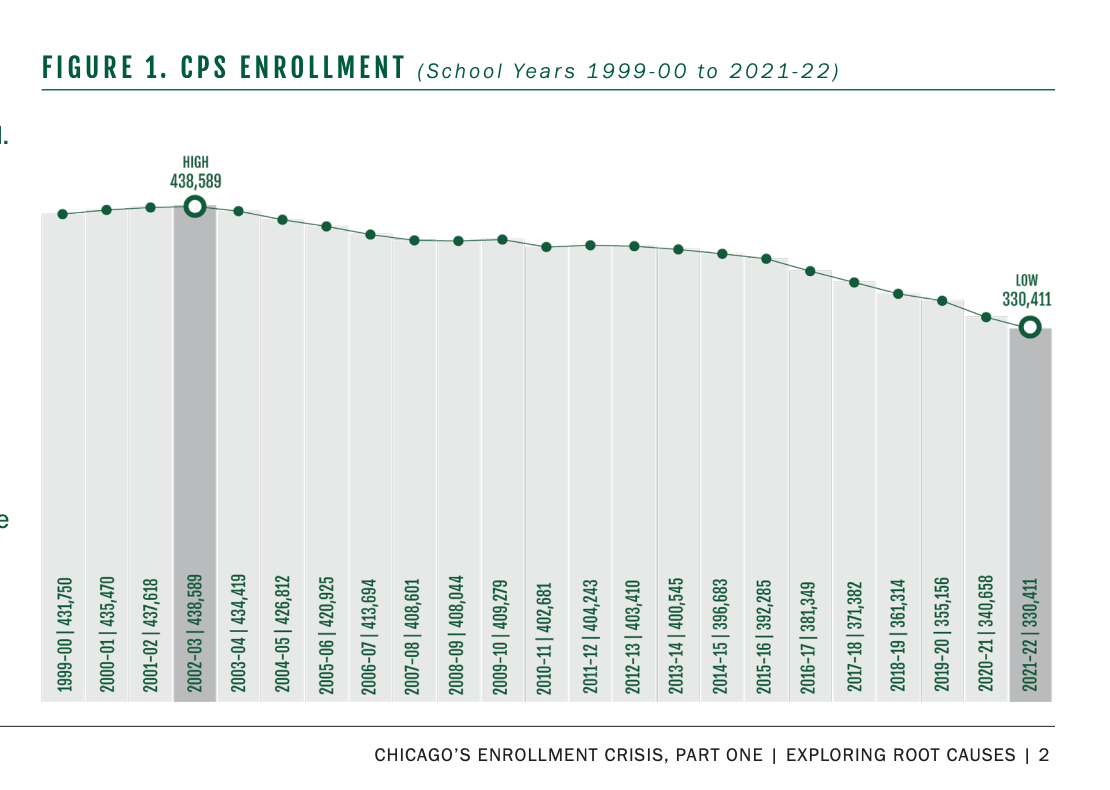
Every year on the 20th day of school, Chicago Public Schools announces how many students are enrolled. The press takes this number and runs the same scary story: enrollment is down, the district is in danger, the future is in question, and hard choices have to be made.
While the press has always run stories about school enrollment in Chicago, the narrative wasn’t always fear. Sometimes, we’d see an explanation of why things changed, like child labor laws going into effect or a world war. Stories about enrollment were short and linked to birthrate. But in 1964, CPS started tabulating student race.
And the story changed when white students became the minority.
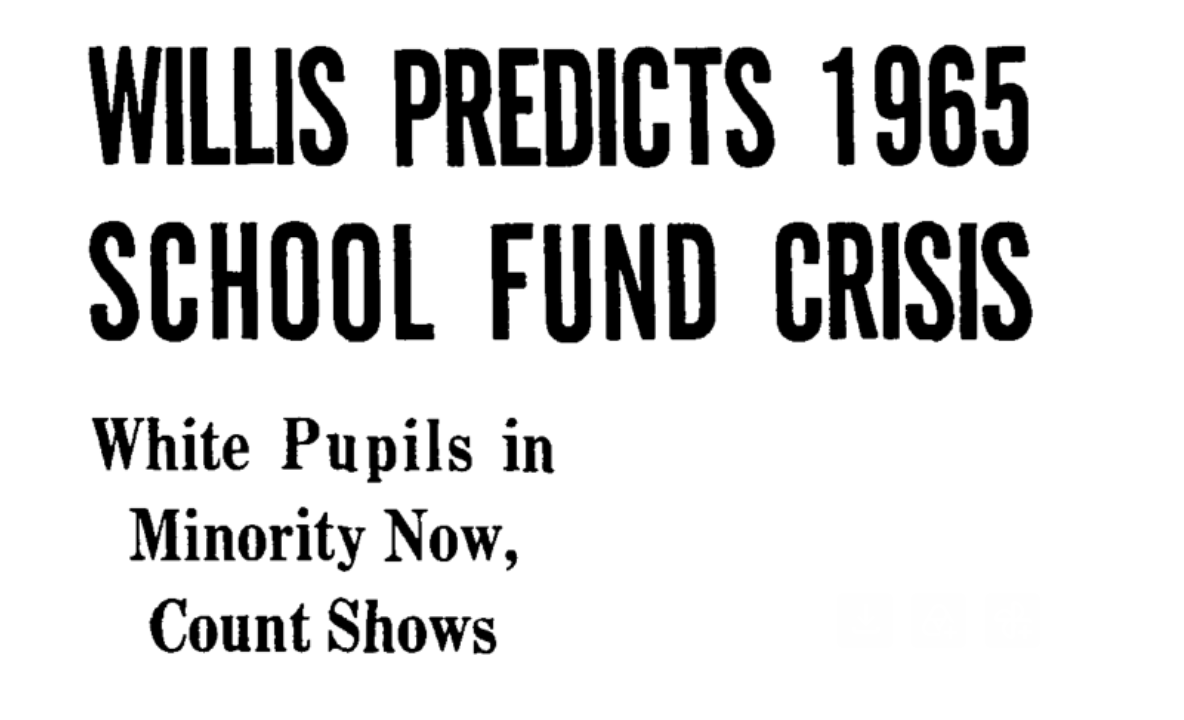
In the years after 1965, the press used stories of declining enrollment to develop a shorthand: people are leaving, leaving the city, leaving its schools; we are in crisis.
By 1980, Chicago Public Schools was ordered by the courts to desegregate; in the same year, the Board of Education proposed closing 22 schools, filled with mostly Black or brown students. The next year's enrollment story was, “Hispanic students in Chicago public schools will outnumber white students for the first time next month and will more than double them by 1984.” A few years later, the Department of Education Secretary would call CPS the “worst in the nation.”
The subtext is for a white child.
These stories built a narrative that public schools should be dismantled because white students are no longer the majority.
Enrollment stories became scarcity stories: what if there's not enough? What if there's not enough for my kids? The implied audience is white families, who are meant to be the readers and not the subjects of these stories. Nothing scares the intended audience more than the idea that a Black child has resources.
The numbers tell a different tale, yet we hear the same story
To be clear: it's not actually about the numbers. “Fewer students, fewer funds” might sound obvious, but most funding for CPS comes from local property taxes.
This isn’t a good way to fund public education, but it does mean funding isn't directly tied to enrollment. Fewer students in the district means more money per student, not less. In recent years, the number of white students in the district has actually risen.
Yet those numbers don't change the fearful story, because that's not where the story comes from. The numbers are slotted in wherever they fit to support structural violence against Black students. The city and the schools use these stories to justify harm--busing Black students but not white students in the 1970s, creating selective enrollment schools explicitly to keep enrolling white students, and demolishing public housing, forcing mostly Black families out of the City.
Education is tied to housing and property taxes because it is treated as a property right. If you buy a house in the right neighborhood, you are buying a good school. The idea that public education is actually for everyone threatens that property right. If everyone can go to a good school, then being zoned for a good school doesn't help your property values.
"What can this year's enrollment numbers tell us about the state of public education?" is not a good question.
Here's a better one: Why do we have attendance boundaries?
This is not a rhetorical question. If we are meant to believe CPS wants to support every school and every student, why can't any student go to any school and experience a comparable educational environment?
Enrollment stories are zoned for whiteness. The school district has a tax base, and students, and choices. The changing size and distribution of the student population does not have to be a crisis. When these stories talk about making "hard choices" to close schools in Black neighborhoods, they are saying, "This is what we have to do to them, to protect us."
What's really scary is how many people are willing to make that trade.
Board Rule's Voter Guide Drops Thursday!
After some arm-twisting, Board Rule cried uncle and created a short-and-sweet voter guide featuring candidate responses to just three questions, plus their one commitment they want to be held to by their communities in two years.
The guide also gathers about half a dozen of the best voter guides out there, so you have everything you need in one place.
But here's the catch. This guide is for paying subscribers. To our paid subs, you all are the greatest and most stalwart supporters I could ever have imagined! This voter guide--with a practical, governance-focused set of questions within candidates' powers should they be elected--is our way of saying "thank you!"
Events
Tonight! Board Rule's Maureen Kelleher co-moderates a CAN-TV livestream forum with candidates from Districts 10B and 6A, 7 p.m. Available on CAN-TV 19, cantv.org, and YouTube.
Or, Tonight: District 3A/B Candidates Forum, including all candidates running in Districts 3A and 3B, sponsored by Noble Schools, 5:30-7:30 p.m., Pritzker College Prep, 4131 W. Cortland St. RSVP via QR code here.
Thurs. October 1: District 5A Forum, Doors 5:30; forum 6 p.m., sponsored by the Westside Branch NAACP with Austin Voice, Board Rule, The Culture, North Lawndale Community News, and more; moderated by Remel Terry, President, Westside Branch NAACP, Michele Clark Magnet High School, 5101 W Harrison St.
Mon. October 5: School Board Presidential Candidates Forum, sponsored by the Westside Branch NAACP with Austin Voice, Board Rule, The Culture, North Lawndale Community News, and more; moderated by Remel Terry, President, Westside Branch NAACP, doors 5:30; forum 6 p.m., Malcolm X College Auditorium, 1900 W. Jackson Blvd.
Wed. October 7: School Board Candidate Forum, MBK Forum Southside Regional Meeting, featuring the presidential candidates plus candidates from districts 6B, 9A, 10A and 10B, 10:45 a.m.-1 p.m., Olive-Harvey College, 10001 S. Woodlawn. Register here.
Thurs. October 8: Focus on Chicago School Board Elections, panel discussion with Joe Ferguson (Civic Federation), Board Rule's Maureen Kelleher, and Jane Charney (Jewish United Fund and CPS parent). 6:30 p.m. in Lakeview. RSVP for details here.
Fri. October 9: 5A/5B Candidate Forum, sponsored by the Parent Engagement Institute Chicago Coalition and other groups, 10 a.m., Kehrein Center for the Arts, 5628 W. Washington. RSVP here.
Sat. October 10: District 7A/B and Presidential Candidates Forum, sponsored by the Coalition for a Better Chinese Community, 10:45 a.m. doors open, program 11:30 a.m. to 1 p.m., Pui Tak Center, 3rd floor.
Wed. October 14: School Board Presidential Candidates Forum, sponsored by Chalkbeat, Hyde Park Herald, and South Side Weekly, doors 5:30; forum 6 p.m., Logan Center for the Arts, 915 E. 60th St.
Comments ()