Declining CPS Market Share
Declining birth rates continue to drive enrollment declines in Chicago Public Schools. But an increasing share of families are choosing other educational options for their children, too.
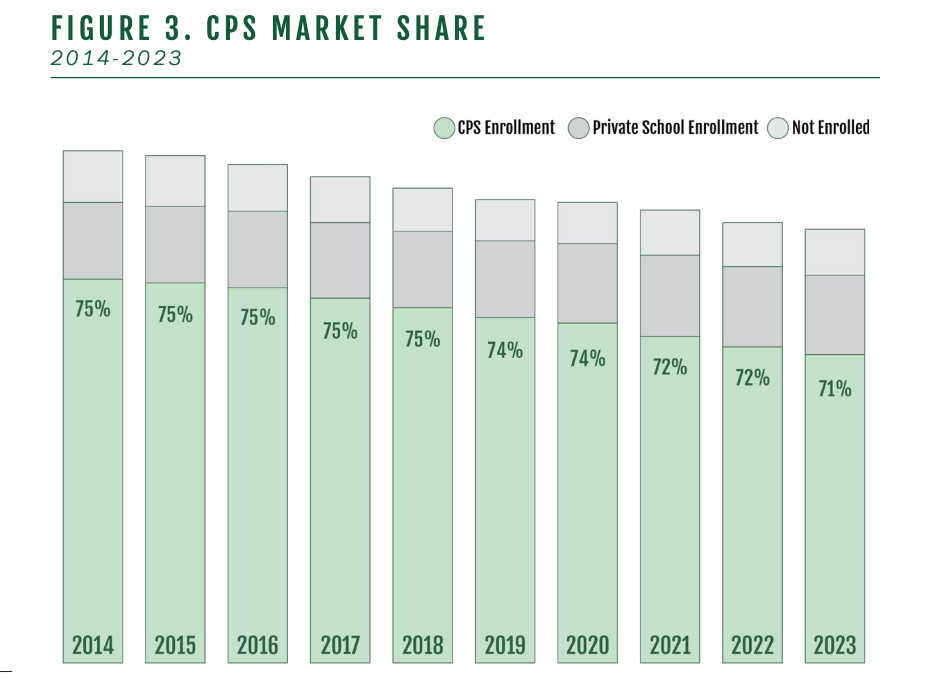
Between 2018 and 2023, the share of Chicago children enrolled in Chicago Public Schools declined by four percentage points. Since 2020, the shares of Chicago children enrolled in private school and categorized as “not enrolled,” which includes homeschooled children, have inched up.
That’s the key finding from a new report published yesterday by the nonprofit education advocacy organization Kids First Chicago. While falling birth rates continue to drive the school district’s enrollment losses, in recent years a larger share of Chicago families appear to be choosing to educate their children outside CPS. It’s important to note that charter schools are included within CPS enrollment, so this means families are choosing private school, homeschooling, or other non-public ways to educate their children.
The demographics most affected by enrollment declines are Black and Latine students. In fact, the shares of white and Asian students in CPS are growing, after all ethnicities saw enrollment declines during the pandemic. This school year, white students make up 12% of CPS enrollment, the highest percentage in many years.
Since 2014, the share of economically disadvantaged students has fallen by 13 percentage points, from 85% to 72% in the current school year. Though Kids First Chicago notes that this number fluctuated, with a bump up from school year 2024 to 2025, and then a drop from last year to this year, the overall trend is down. Kids First Chicago points to both population decline and gentrification as factors in this change.
As organized by CPS network, the geographic area of the city that saw the steepest enrollment decline was Network 8, which spans Back of the Yards, Brighton Park, McKinley Park, and portions of Gage Park, Englewood, and West Englewood.
Last week, a Brookings analysis estimated net-negative migration from the U.S. in 2025 for the first time in at least 50 years, and predicted the same for 2026. It’s early to definitively establish the effects of the Trump administration’s tightened border controls and mass deportation push on enrollment. But CPS had enjoyed a two-year reprieve from enrollment declines, thanks to an influx of mostly Venezuelan immigrants. That ended last fall, when enrollment dropped by 2.8% compared to the 2025 school year. On the ground, Chalkbeat Chicago reported that principals and LSC members in Latine-majority schools reported speaking with families who had moved to the suburbs to get away from ICE activity, and others who had chosen to return to their country of origin in Latin America. But longstanding issues like gentrification continue to play a role.
For CPS to regain market share, Kids First Chicago recommends cultivating strong leadership, stable finances and engaging programs, possibly by having multiple small schools pool their resources. “It’s essential to monitor Chicago’s student population as it continues to change in size, composition, and need,” Daniel Anello, chief executive officer of Kids First Chicago, said in a statement. “Monitoring these trends over time helps us understand and plan for their impact on the student experience. Classroom resources, school programming, and the supports available to families are all on the line.”
For more:
Chalkbeat Chicago story on the report
CPS enrollment presentation on 2026 enrollment and trends
WBEZ story on the report
InFocus: Ellen Rosenfeld
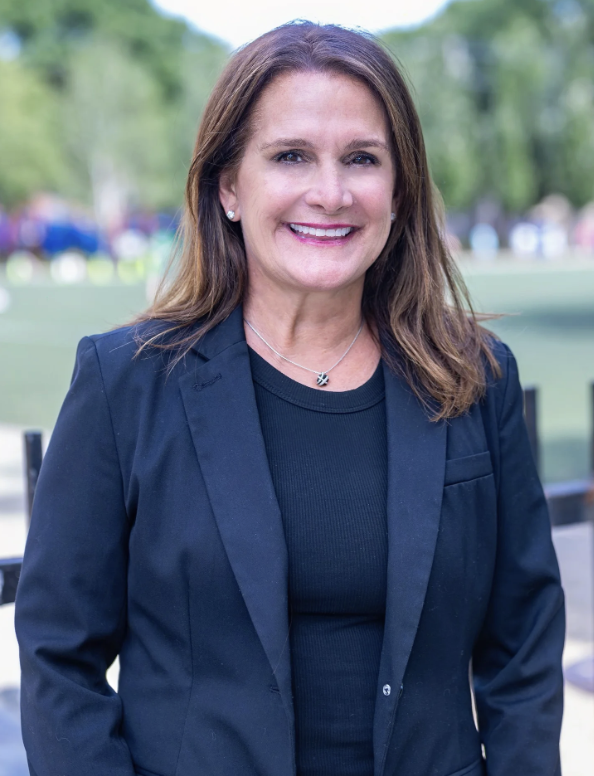
Before becoming a school board member, Ellen Rosenfeld had experience with CPS as a teacher, a parent, Local School Council board chair, and work experience as a family and community engagement (FACE) specialist for Network 1 schools on the north side of Chicago. But, she says, joining the school board was still an eye-opener. "I think my biggest surprise has been just how slow and difficult it is to truly to get things done."
Rosenfeld first connected with CPS as a teacher at Dulles and Hartigan Elementary schools. Later, she worked as a substitute teacher while her own children were CPS students. All four of her children are CPS graduates. Rosenfeld chaired Bell Elementary's Local School Council for six years, then went on to work as a FACE specialist before running for the school board.
While she's proud of the work she's done in her first year in launching a newsletter, building partnerships, and visiting schools, she sees plenty of room for the board to improve. She'd like to see the board set a vision, focus clearly on policy, create in-house professional development for board members, and restructure the public comment process to allow for a wider range of community views. Currently, organized factions pack the speaker lottery to ensure at least one of their members gets speaking time, but that can shut out individual issues. "It's not fair when one group gets 10 spots, or one organization takes the majority of the time," she said.
She's looking forward to what a fully elected board will be able to do. At the same time, she expressed concerns about how the school board will govern while campaigning--an issue Chicago has never before faced. And she's concerned about the amount of money likely to be spent on campaigns, given that the partially elected board saw more than $13 million spent on elections in 2024.
As the spouse of 47th ward committeeperson Paul Rosenfeld, she's no stranger to the power of organized local politics. And she's aware that less than one-third of Chicagoans know the school board will be fully elected in November. "It's never been so important for people to understand that all politics really are local," she said. "I hope the players in education get out there and start informing people about this election and why it's important," she said, and pointed to the newly-formed Chicago Education Alliance as a hopeful sign for public informing.
Priority: Reducing school absenteeism. "We can't teach them if they're not in seats." She paid close attention to the recent UChicago Consortium report on attendance and the importance of a strong sense of safety at school to help students attend consistently. "I can continue to ensure that we follow up and make sure that there is a whole school safety plan in every school, so families and students feel safe," she said.
Soundbite: "If I could have one wish, I hope that the next board starts with a goal and a vision. ... We still never quite established that as a board."
The full interview was sent to paid subscribers, who can read the full Q &A here.
Comments ()