Expect Another Bruising Chicago Public Schools Budget Cycle
Chicago will need to sweep TIFs again this year to shore up both its own and the school district's budgets. But the bonanza may not be as big this time.
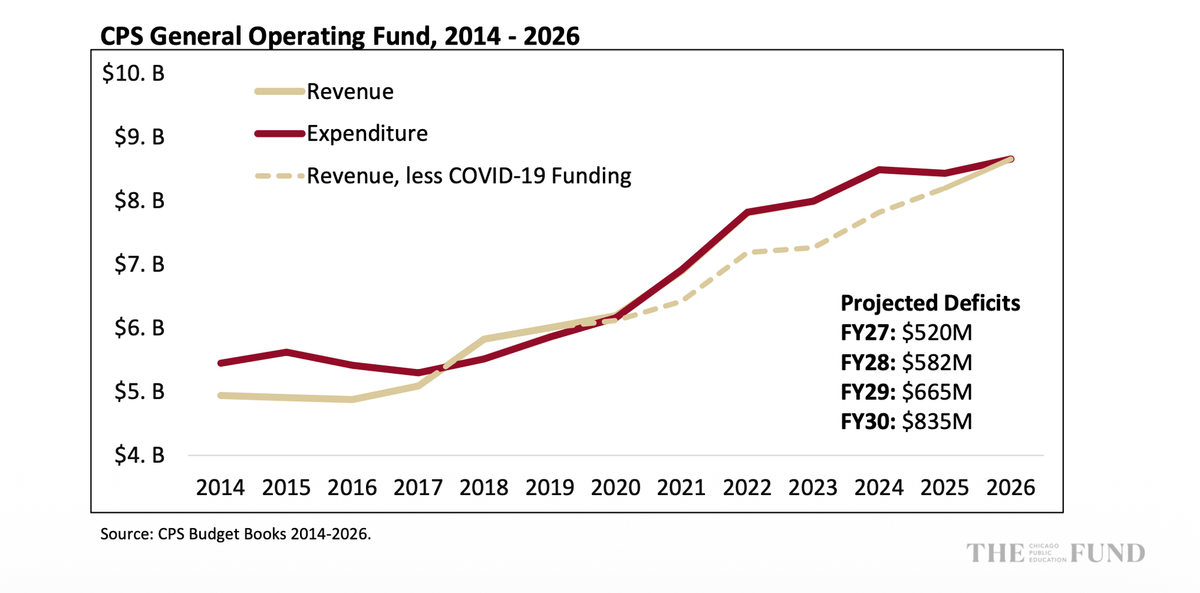
Last August, to the surprise of many observers, the Chicago Board of Education worked with Chicago Public Schools leadership to pass a budget that did not include borrowing. It wasn't easy. And doing it again could be harder this year.
A record-breaking $1 billion TIF sweep from the city helped fill last year's deficit. Many of the city's TIF districts are now producing peak revenues, refilling their coffers quickly after being swept for surplus. But as the Civic Federation, a government watchdog group, explained, there's a catch: in 2025, the city tweaked its TIF sweep policy, reducing the length of time City Council members could hold TIF funds for planned development projects. The release of long-held TIF money earmarked for development projects on the back burner created a one-time windfall. It's unclear how much of last year's TIF bonanza came through this one-time bump in available funds.
Last year's budget made a small but significant dent in the structural imbalance between spending and revenue that creates deficits. CPS said last year's cuts netted $263 million in structural debt relief, and the decision not to make a city pension payment that includes nonteaching CPS staff without additional revenue prevented another $175 million from adding to the debt burden. This reduces the expected deficits in future years, but doesn't eliminate them.
Without big changes that require state lawmakers' approval, the long-term picture remains grim. Most of today's TIF districts will expire starting in the early 2030s. While this process releases funds back to schools, parks, and libraries, the expiration of TIF districts will close a loophole that CPS has used to increase taxes beyond annual caps set by law.
Springfield lawmakers are now considering approving a ballot referendum that could create a millionaire tax of 3% above the state's flat income tax rate. The money raised would be evenly split between new money for schools and property tax relief. The measure heads to the House floor this week.
Where Are the School Budgets?
The FY 2027 budget season is off to a slow start. Back in March, the Chicago Public Education Fund recommended that Chicago Public Schools leadership release school-level budgets as soon as possible. That didn’t happen. It’s now late April and schools don’t yet know whether their staffing will stay the same or change in next year’s budget.
Here’s why that’s bad news.
Back in the Janice Jackson era, schools got their budgets for the next school year in April, rather than during the summer, as happened last year. Giving principals their budgets in the spring has many advantages. Here are a few:
- Spring budgets reduce the need to cut or add jobs in early fall, after official enrollment counts, which disrupt classrooms just as students and teachers are getting to know each other.
- With budgets out before the end of the school year, most teachers can rest assured they will have a job at their school in September. Any teachers losing their positions can find a new spot well before summer vacation, and schools where new positions open can hire teachers in peak season, not struggle to fill vacancies in August, September, or later.
- If budget mistakes are made, schools have months to push back and resolve errors before the new school year starts.
Also, releasing school budgets in early spring would be a good sign that CPS will be ready to release its central budget for approval in June or July. So far, that hasn't happened. Multiple board members have told Board Rule that they would like to approve a budget sooner than August this year, especially since they will be moving into campaign mode by late summer.
What to Watch at Thursday’s Board Meeting
Here are a couple of key items on the board's April meeting agenda.
The board is expected to approve opening the public comment period on changes to its comprehensive non-discrimination, harassment, and retaliation policy. The most significant change is to include citizenship status as a protected category. Public comment is expected to begin Friday, April 24 and the public will be able to comment here.
After public comment and a 30-minute recess, the board will receive a presentation titled "Measuring What Matters: MOY Data and the OMME Newcomer Journey." This looks like an opportunity for some public discussion related to student learning; in this case, what midyear testing data shows about the academic progress of newcomer English learners.
May Day Madness Isn’t Over
On Monday, the Urban Center, a centrist political organization that supports school choice, held a press conference with parents who expressed concerns about what curriculum and activities students might engage with on May 1. According to the Chicago Tribune, parent Judy Velez will attend Thursday’s board meeting in hopes of learning more about the lessons and activities planned. Board Rule expects she will not attend alone.
Last week, Chicago Public Schools and the Chicago Teachers Union agreed to designate May 1 as a day of civic engagement.
Also Monday, Kids First Chicago released a poll of about 700 Chicago Public Schools parents showing that 61% favored keeping school open on May 1. In a statement, members of the executive committee of Kids First’s Parent Advisory Board said the following:
“Chicago parents have a range of views on May 1. What unites them is frustration with being left out of the decision-making process on an issue that directly impacts their children and daily lives. Some families would face real challenges with childcare and work. Others welcome the opportunity to stand in solidarity. And some simply want clarity so they can plan.
As Chicago transitions to a fully elected school board, we implore board members to include parents in decisions that affect our children, not make them without us.”
Watch for more quick takes from Kids First parents on hot-button issues. "This was an opportunity for us to test a rapid response poll,” said Hal Woods, chief of policy for Kids First. “We expect to do more of this going forward. Part of the goal is to make clear that if families are not brought into the process, we will continue to elevate their perspectives in real time."
Election Updates
Two of Chicago’s media outlets recently launched their coverage of school board races. Both gave the basics: what the school board does, how the elections work, and the timeline for candidates to get on the ballot. But each story had its own flair.
WTTW gave the short version of the advocacy efforts that got Chicago to an elected school board.
WBEZ noted the two key interest groups likely to face off in the races: the Chicago Teachers Union and the Illinois Network of Charter Schools.
Other outlets are digging into campaign spending.
Chalkbeat Chicago’s Mila Koumpilova took a deep dive into school board candidates’ latest reports on their campaign cash.
And the Chicago Tribune’s Kate Armanini reported that the CTU wants to raise members’ dues to plug an expected deficit and replenish its campaign funds in time to support school board candidates. The Members First caucus is already pushing back.
Comments ()