InFocus: Ellen Rosenfeld Q & A
"My dream would be that we, as a board, come up with a statement of clear, shared vision," says school board member Ellen Rosenfeld.
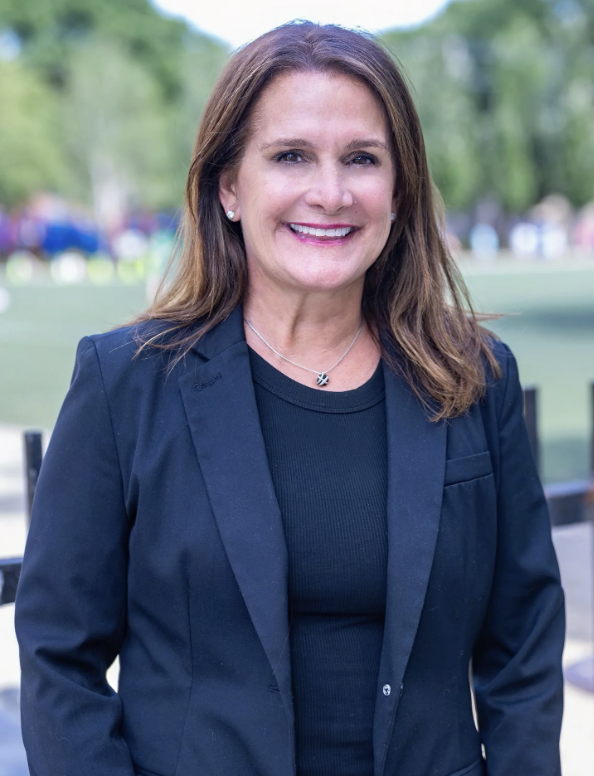
Q. What would you like people to know about your first year as an elected Chicago school board member?
A. I remember walking into that boardroom a year ago and taking that oath. In some ways it feels like it's been a decade, and in some ways it feels like it's been a couple months.
I think my biggest surprise has been just how slow and difficult it is to truly to get things done. You know, the size of our district, the obvious complexity of a $10 billion budget, and then people who come with their own agendas. So I've just been surprised.
I've learned how much patience I have, and persistence I have, and, you know, I have a lot more willingness to navigate the nuances than I ever knew that I was capable of.
I compare Ellen January of 2025 to Ellen January of 2026 and I think I'm really finding my voice. I think I'm starting to understand for me what truly matters, and finding a way to elevate my voice in a very large, diverse board that's starting to make a real difference. That's kind of exciting, and I can only imagine what a four year, fully elected board is going to bring, right? I'm really looking forward to that.
Q. I know you and Carlos [Rivas] did training with School Board Partners. What did you learn, and to what extent have you been able to put it to work?
A. What I learned at School Board Partners was all the things that I didn't know I needed to know. I made connections in School Board Partners that I am still reaching out to [in] school boards across the country, like when we were voting on budgets and property taxes and all of these things.
I learned how important the decisions that we make as a board and what I come in with, whether that be my personal biases, you know, my history with Chicago Public Schools, I'm much more conscious of how that affects the way that I vote, and so I feel like I became more open-minded and understood the really importance of getting informed and recognizing me my own personal biases, and how I bring that to the table every single time I show up and make a decision about Chicago Public Schools.
I hope to do more continuing education like that. I hope that maybe the board's going to offer more stuff like that as we go forward.
If I could have one wish, and I did learn this with School Board Partners, I hope that the next board starts with a goal and a vision. You know, we still never quite established that as a board, and so sometimes I'm not positive what we're working towards. So my dream would be as soon as January 15 of 2027, when we take our seats, that's one of the first things that we do. We, as a board, come up with a statement of clear, shared vision and a clear, shared goal, and then we work toward that. That's not always the case in this current situation.
Q. What are you most proud of that came out of Year One?
A. I think I have increased the transparency and I have increased the accountability of the district. So, how have I done that? I do a newsletter. I make statements, you know, I explain why I voted the way I voted. I call for meetings with district leaders if I don't agree with something or I need clarification, and then I share that information.
Q. What’s your priority for the coming year?
A. If I could pick one thing, and there's so many, but absenteeism, just to to see what I can do to help decrease absenteeism. We can't teach them if they're not in seats. If my priority can be attacking chronic absenteeism by using the data that people like those very smart people from the University of Chicago Consortium that take the time to understand it and talk to people, and then are kind enough to come to the meeting and provide us with that information. And not only that, they give us their contact information, and they give us their articles.
So what am I tasked with? Reading it, understanding it, and seeing what I as a board member can do to help. They said that supporting students with 85 to 95% attendance is where we can really make a difference. Communicating with parents about absenteeism matters, why attendance is important.
Q. In your conversations with folks at office hours and in visiting schools, what have you seen happening around attendance?
A. I had a parent come into one of my office hours and she wasn't in District Four, but she signed up. She told me that she went in to talk about her child, and when she walked in the building, no one said a little door. And then she waited so she wasn't greeted. That seems like such a simple thing, right? And what she ended up doing, walking out of the building, walking right back out.
Another family, whose son didn’t make, I think it was the basketball team, was the only one who didn’t make it. The way that child was told they didn’t make the team–it was listed, they all went there, and he was the only one that didn’t make it. He didn’t want to go to school the next day.
So when I say a strong school climate and a strong culture, these are the things. Because when kids feel scared or anxious or they don't want to go, it's very hard as a parent to fight that every single day, especially if you're a parent that's fighting a whole bunch of other stuff.
I don't think the things we need to do are all that ginormous at every school. And I’ve come to understand that the role of a board member is not the same as the role of an activist. I try to stay professional and take the information I have, share it with partners, and then step back and move on to the next thing, because that’s my job as a board member.
Q. If you could take a minute to share a couple of your biggest frustrations with the current situation.
A. I don't have a solution there, but it's frustrating. It's a lot of five by fives, four by fours. You know, a lot of, Oh, will you sign on to this letter? Oh, will you support this resolution? Sometimes I'm afraid we're a body that governs by letters and resolutions. And I don't like that. I don't like that at all, so I would like that frustrates me, because then it becomes like, Oh, she didn't sign on to this letter or this resolution instead of policy.
I'd like to think of a better way to do public comment. It's not fair. When one group gets 10 spots, you know, or one organization get takes the majority of the time, I wish. And I think about this all the time, and I talk to my friends on the board, how can we do this differently? I really would get frustrated with public comment. You know, I don't know that it does what it's supposed to do. I question that thing. I felt that way, even when I worked at Chicago public schools and I was in FACE, I always wondered, Is this really representative of the public?
But the most frustrating thing for me, and I told you this earlier, is that we are a school board without a vision. It's never been established. It's never been discussed. So half the time I don't even know which direction we're going. I don't know what, what what we as a board, value or prioritize exactly, because there's so many things in CPS that we can make better.
Q. OK, so, the path to 2027. Do you have some thoughts on that?
A. Here's the thing about 2027, right? We pass our petitions in February, right? So that's like, right? That's coming up today. So we again, after that, reflect on one year. I'm just getting started now. In addition to again, budget and school charter renewals and all of that stuff, we're also going to all be candidates, or whoever's running, and CPS has never had sitting board members as candidates, right? So I am a little bit concerned about what that all looks like, and how we make sure that everybody is doing the right thing, and, you know, focusing on the right things when we're working for the board, and then separating that from candidacy. When I was a candidate last time, I worked for CPS, and I was very, very careful of never mixing those two things. I didn't do campaign work during my work time at CPS, and I'd like to see that happen here. I know there will be different ethical concerns with us being candidates and being board members, but I hope there's some training around ethics before we all start to run, or whoever starts to run. I'm just starting to hear people talk about it. You know, truth be told, I haven't really talked a lot about it either with other board members, so it'll be interesting to see who's running, yes, right? Who decides that you know one one go at this was enough.
Both are to be commended, whether you run again or one time serving, because it takes a lot of time. And you know, as you know, it's unpaid. Yes, there's a lot to read, there's a lot to learn. Absolutely, that's not for everybody, right?
Q. Well, this goes to the calendar as well. This year you really don't want the budget to be dragging into August, because that's going to get awful close to the peak campaign season.
A. That's exactly right. And we don't want charter renewals to go on and on either. That goes back to my deep desire for committees. We should be working in committees so that we can start to piece some of this out and have meaningful discussions and bring those back to the board, the whole board.
It's never been so important for people to understand that all politics really are local. I hope that the players in education get out there. That's what makes me hopeful for something like Chicago Education Alliance, get out there and start informing people about this election and why it's important and how it affects you as a Chicagoan, whether you're it's because you care about your property taxes, or you care about your children or your grandchildren, or you just care you care about the kids in CPS.
Comments ()