Student Learning Takes a Back Seat to Charters
A full-year analysis of the Chicago school board shows charter issues take up a disproportionate share of time, and student learning gets shortchanged.
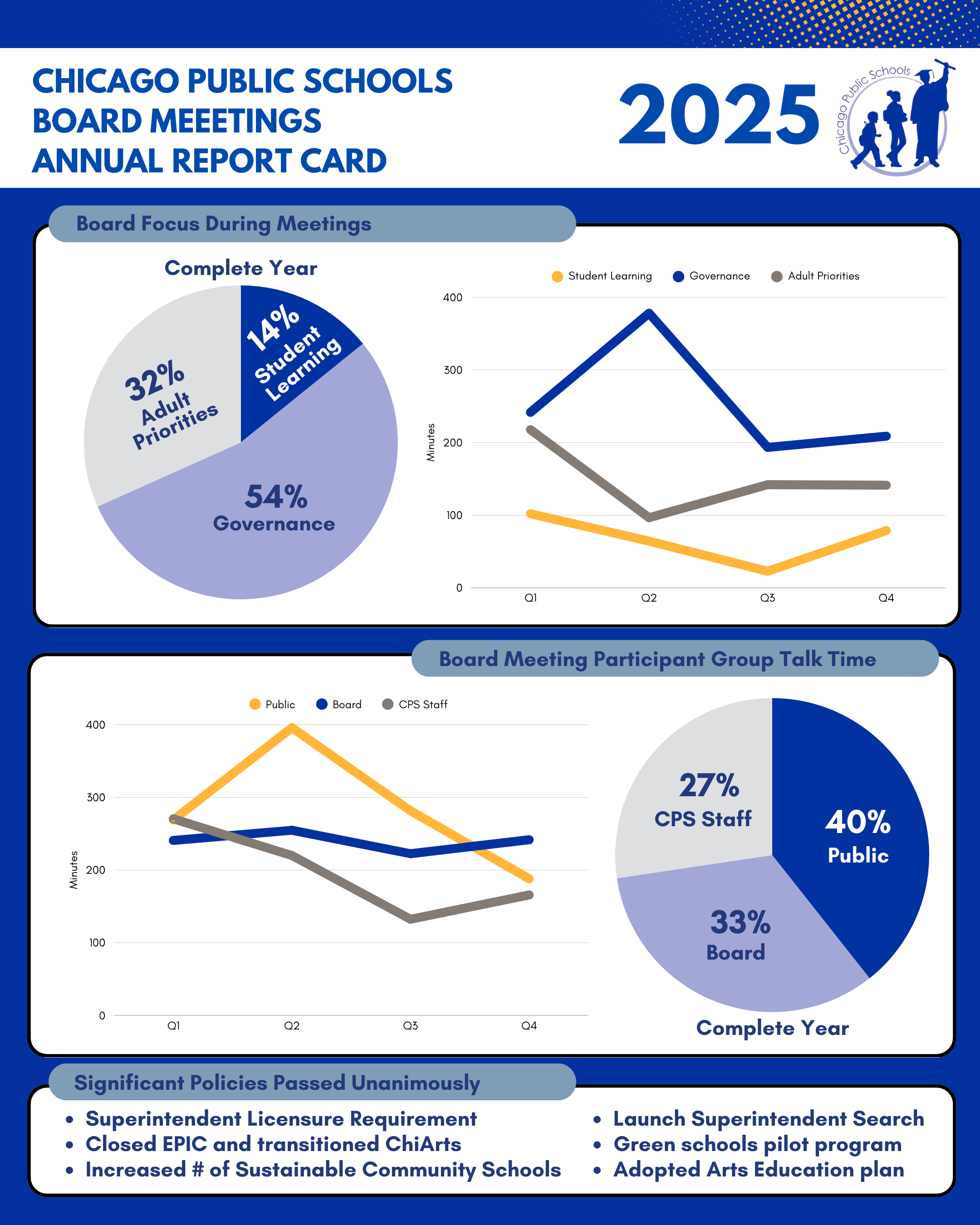
Adam Parrott-Sheffer has not only compiled four quarterly report cards analyzing public comment and school board discussion, but he has also created a full-year analysis that also tracks board members' meeting attendance and school visits. For a printable version of this annual report card, click here.
By his reckoning, only 14% of the board's public meeting time focused on student learning. At the same time, Parrott-Sheffer notes half a dozen substantive decisions the board made unanimously, from launching the search for a new school district leader and requiring the new hire to hold a superintendent's license, which had not been a requirement since the 1990s, to adopting an arts education plan and piloting green schools.
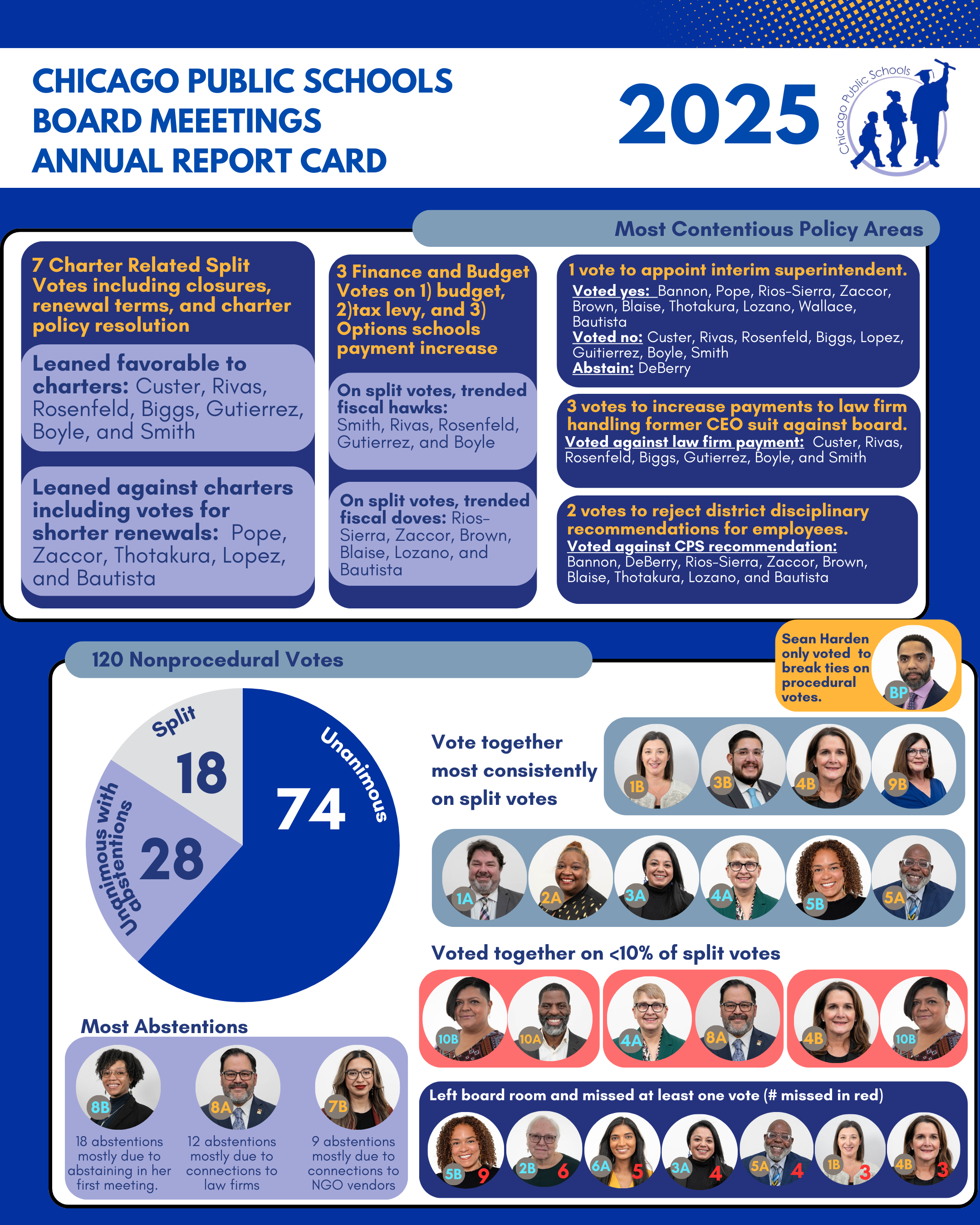
While the majority of substantive board votes were unanimous, some issues divided the board. Charters, finances, and the vote to approve Macquline King as interim Superintendent/CEO were among the highest-profile controversial votes.
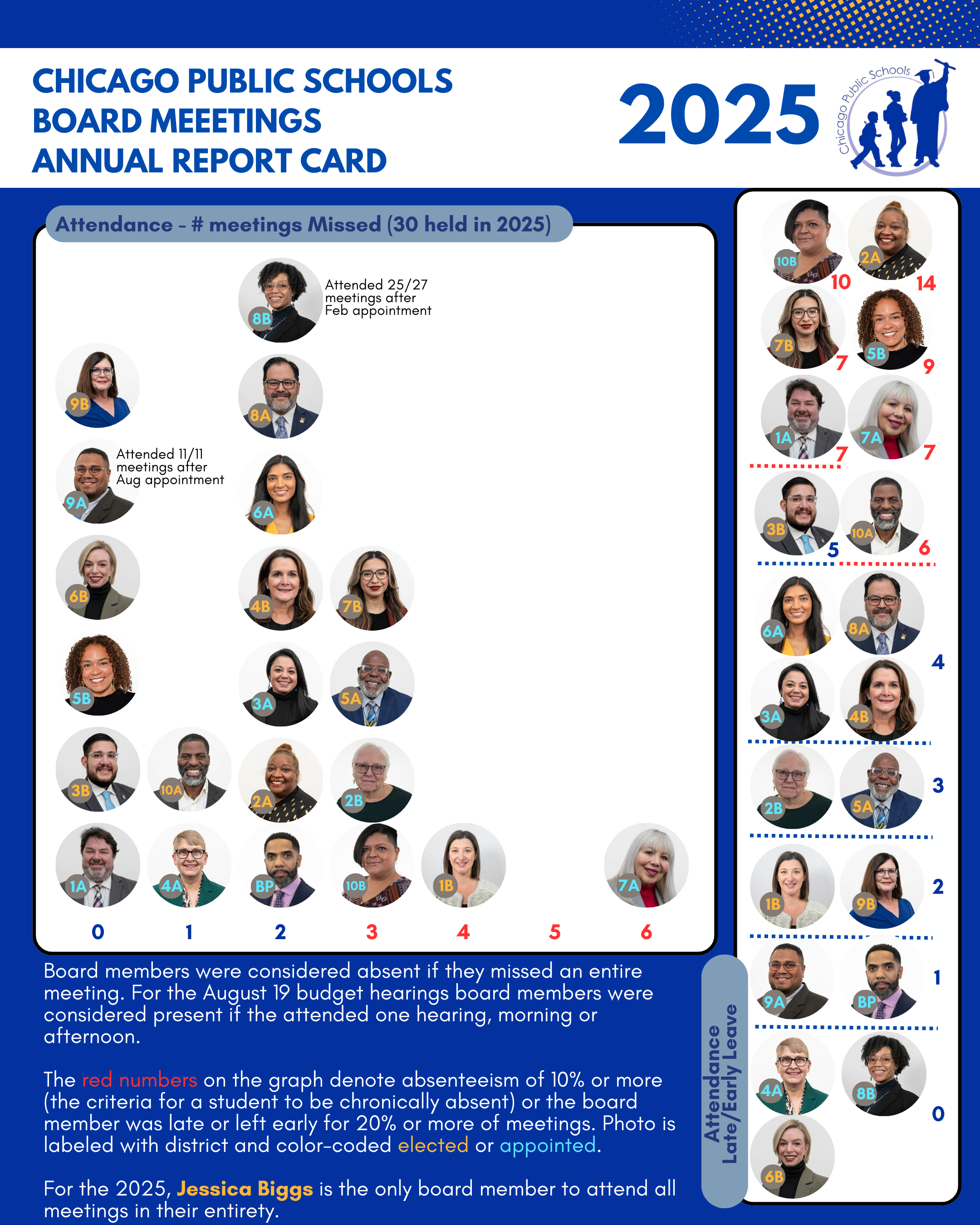
In 2025, only Jessica Biggs earned perfect attendance at board meetings.
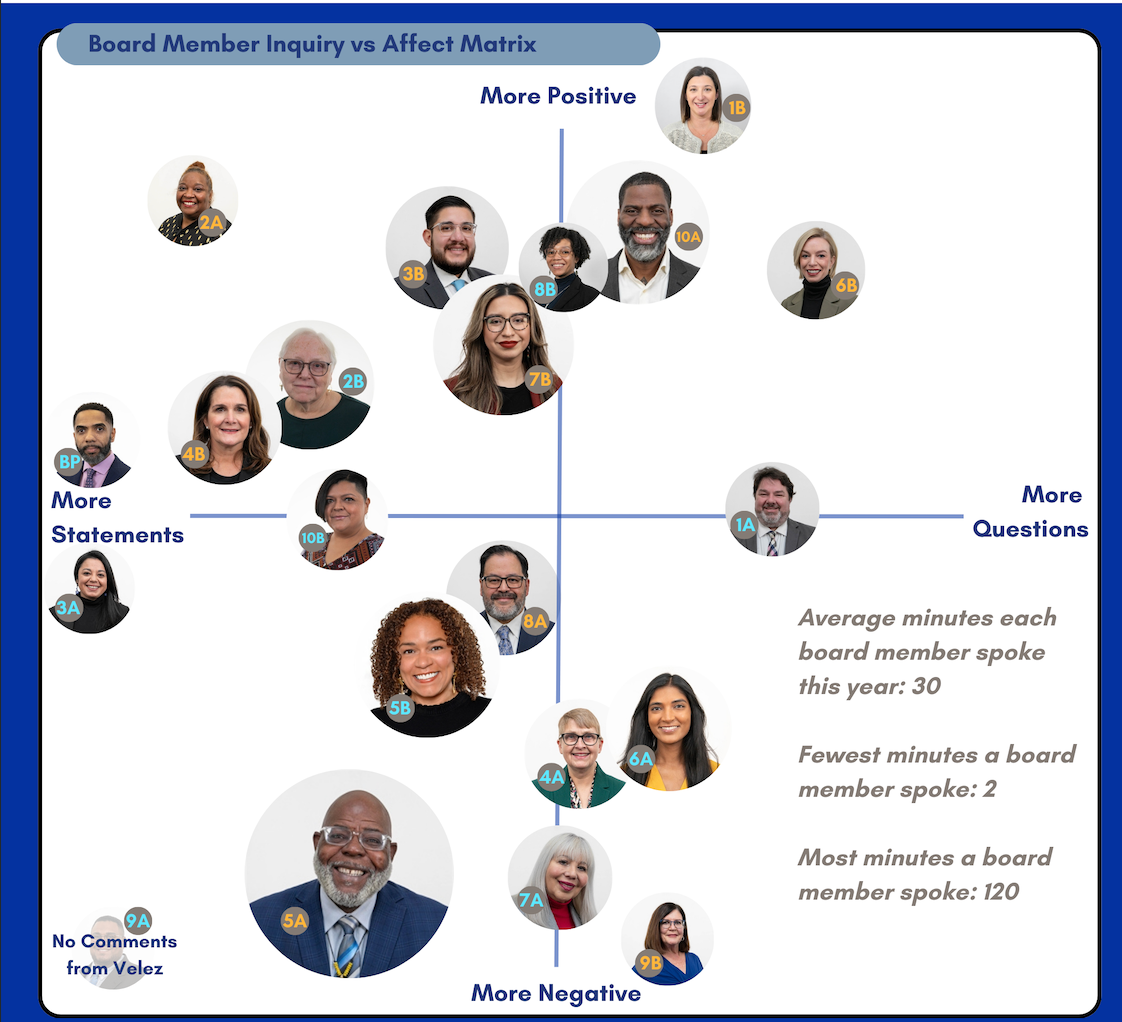
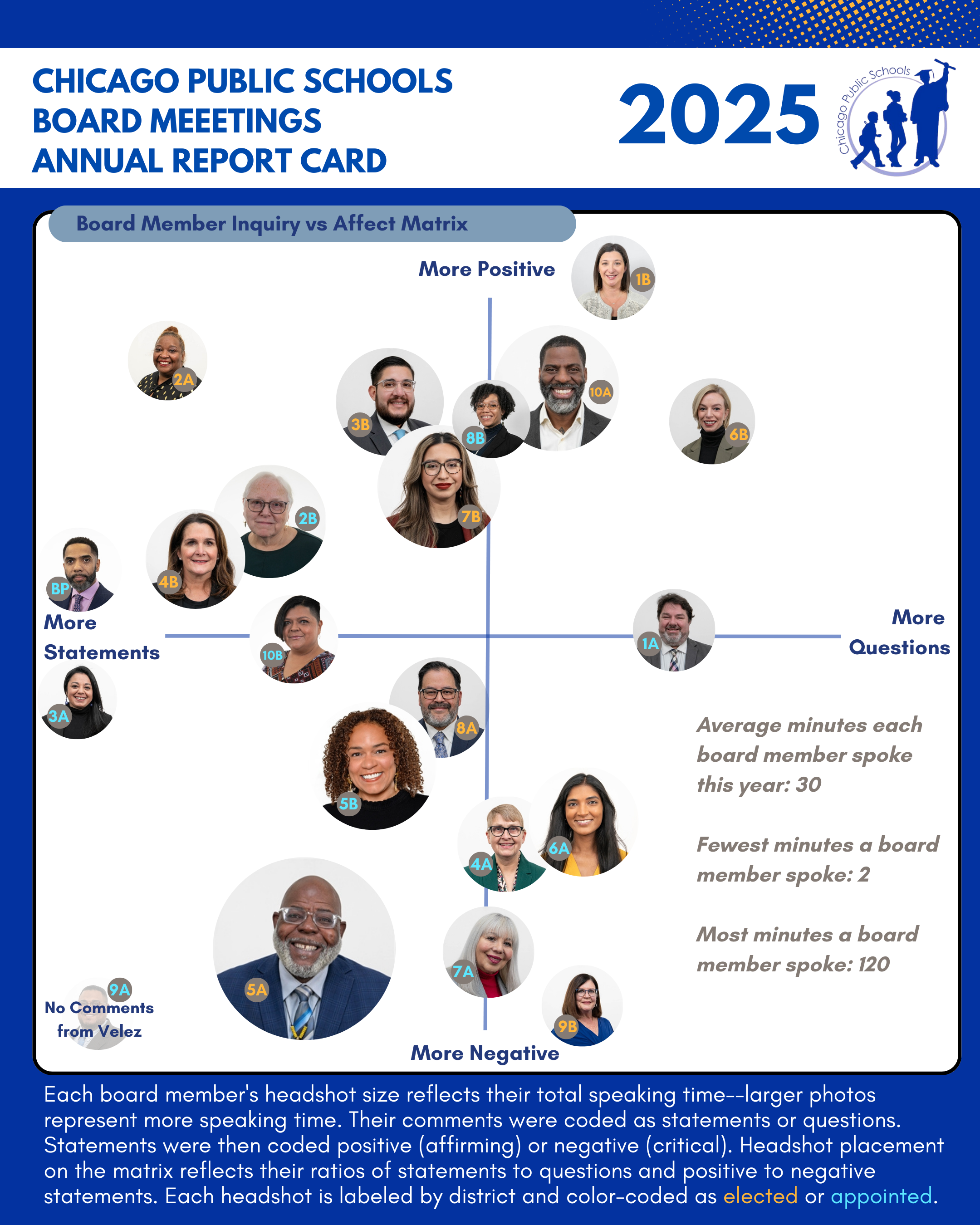
To analyze board members' speaking time and the substance of their remarks, Parrott-Sheffer created a chart where the size of each member's photo reflects their total share of speaking time during 2025 board meetings, and their placement on the chart reflects the mix of comments vs. questions and positive vs. negative tone to their remarks.
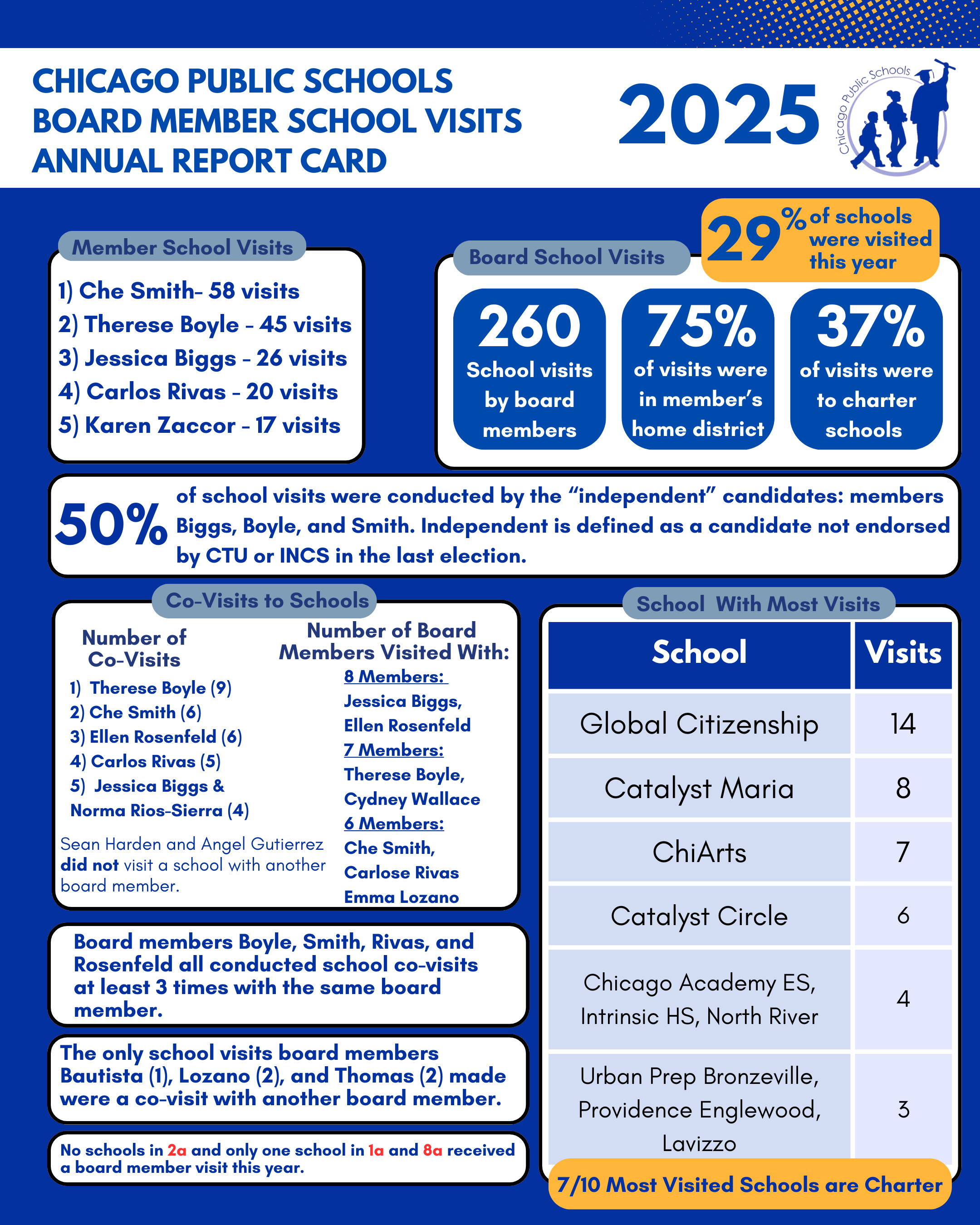
For the annual report card, Parrott-Sheffer obtained records of all the board members' visits to schools during 2025. While the literature on school board governance is mixed on the value of school visits, Parrott-Sheffer sees them as an important opportunity for board members to interact across differences and build a common set of experiences from which to make decisions.
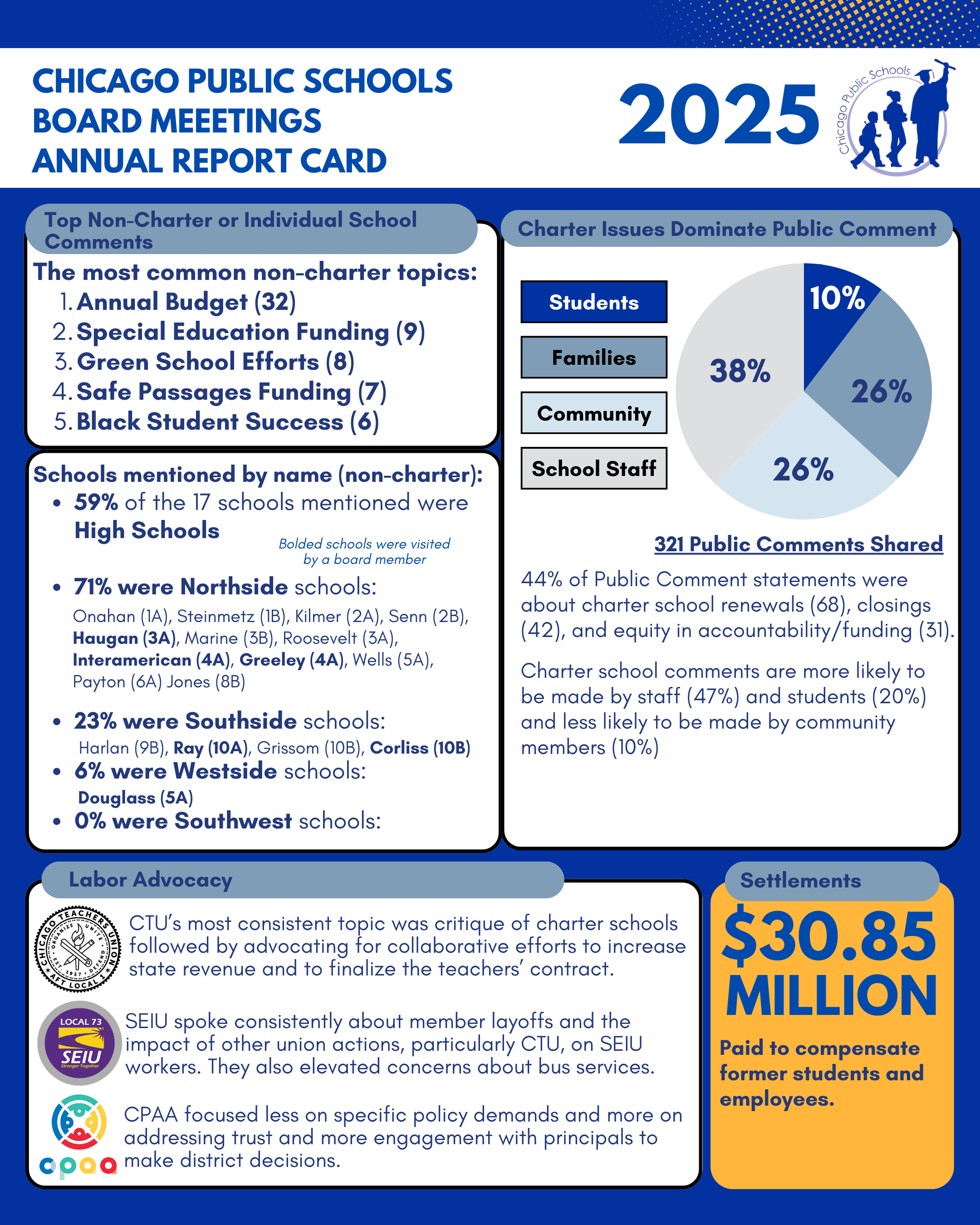
Charter issues took up a disproportionate share of public comment, and the majority of district-operated schools discussed in public comment were located on the North Side.
Key Takeaways:
- Charter issues are taking up a disproportionate share of the school board's public time, both during meetings and in school visits, and of the time allotted for public comment.
- About one-third of board members mostly made positive statements during meetings. Board member Jitu Brown spoke the most, with many statements coded as negative. Board member Angel Velez spoke the least.
- As is true for many school boards, Chicago's board spends the least amount of its public time explicitly focused on student learning.
Chicago Education Alliance Launch Party Draws a Clout-Heavy Crowd
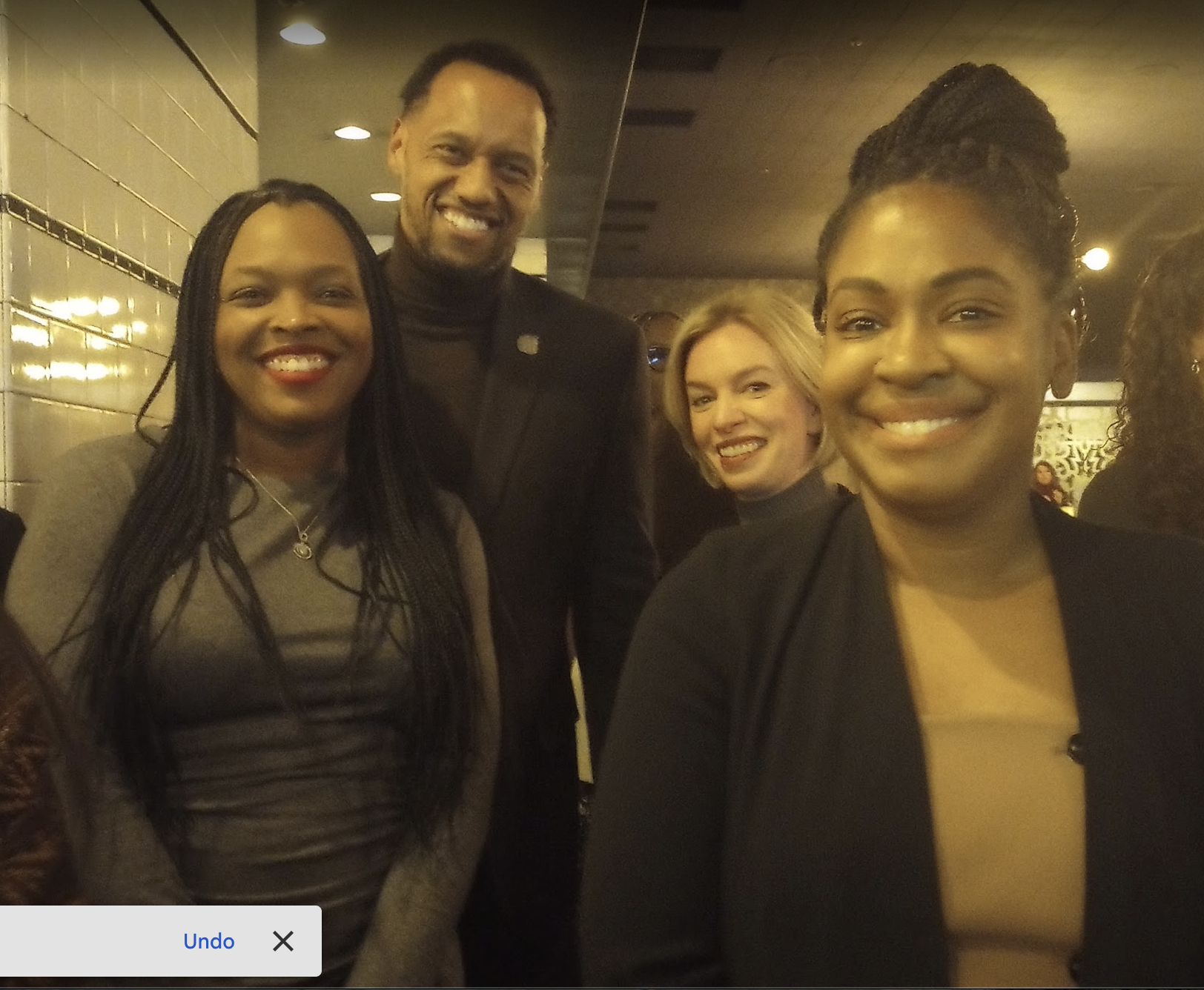
About 200 people braved a bitterly cold, sloppy Monday night to toast the official launch of the Chicago Education Alliance. Among those in attendance: Martin Cabrera of Cabrera Capital Markets, former deputy governor for education Jesse Ruiz, Interim Superintendent/CEO Macquline King, Beth Swanson, executive director of A Better Chicago, and Maurice Swinney, chief innovation officer with Chicago Beyond.
Correction from first edition: Eight board members also joined the festivities: Jessica Biggs, Michilla Blaise, Therese Boyle, Jennifer Custer, Angel Gutierrez, Debby Pope, Carlos Rivas, and Ellen Rosenfeld.
What lured people out on a miserable night in January? The sheer level of interest in the new organization was a draw, according to one attendee. "I think there's a lot of curiosity about what it's going to do," she said.
Founding executive director Arnie Rivera gave some new details about the work ahead. He pledged to focus the early work on "fiscal stability, effective governance and data transparency." He described effective governance as "mak[ing] sure that we have a student-centered agenda at a time when we're transitioning to a fully elected school board."
Rivera also promised a "deep listening" tour through Chicago's neighborhoods to surface insights related to the three priority areas. He pledged to use "a human-centered, co-design approach" to develop a policy agenda with community leaders.
As WBEZ recently reported, the Chicago Education Alliance is launching with more than $5 million already secured from a core group of foundations: The Joyce Foundation, Crown Family Philanthropies, Schreiber Philanthropy, Steans Family Foundation, and Vivo Foundation. Rivera has opened a search for a chief operating officer.
Thursday’s Board Meeting Preview
Here's what to watch for, and what won't be on the agenda this month.
Delayed business: The board is scheduled to vote to delay approving its advocacy agenda for the 2026 legislative session, which usually happens in January. “The CEO and Board need additional time to review the Legislative Agenda.” Interim CEO/Superintendent Macquline King will present the agenda “in early 2026.”
Charter renewals, another item traditionally voted on in January, are also not on today’s agenda. I’ve been told by multiple sources that the 2026 reneweals are expected to be on February’s agenda.
Increase in short-term borrowing. The board will vote on a $400 million increase in short-term borrowing to cover cash flow because of continuing delays in receiving property tax funds from Cook County. Chalkbeat Chicago covered the topic earlier this month.
Repurposing Closed Schools. The board is set to approve the sale of two schools shuttered during the mass closures of 2013:
Armstrong, 5435 W. Congress and 5400 W. Harrison (Austin), to BreakAway Community Development for a youth athletics facility.
Paderewski, 2221 S. Lawndale Avenue (Little Village) to P3 Markets LLC for redevelopment into 86 units of affordable housing and a freestanding community center.
Personnel decisions. Next week, we’ll review the LSC appointments, principal contracts, and employee disciplinary actions.
Take Our Survey!
We want to learn more about Board Rule readers. Please make time for a brief survey to help us better understand our audiences. Survey respondents can choose to enter a drawing for a $100 gift card. Thanks for helping Board Rule get to know you better.
Comments ()