Tech Week: CPS Puts the Brakes on Gemini in High Schools
In theater, tech week is the final week before the show opens. It's the last chance to iron out any problems before the audience sees the performance.
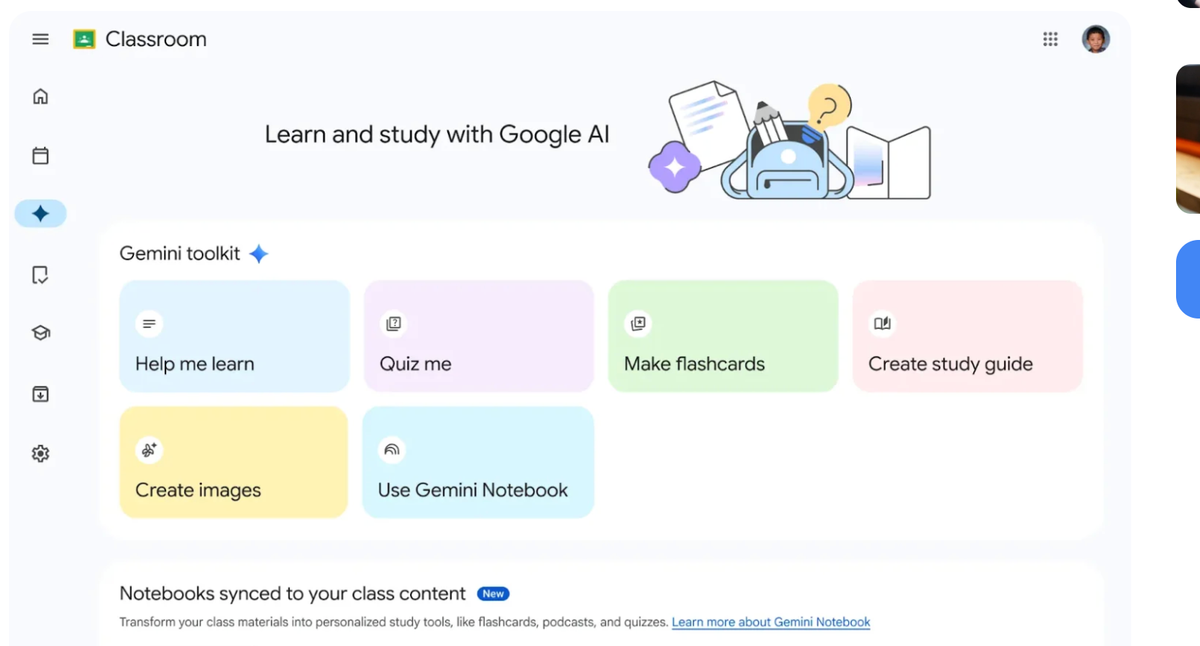
This week, the final week before the new school year starts for students, Chicago Public Schools chose to pause rolling out Google's Gemini AI assistant to high school students.
Nationally, on August 10, Google made Gemini available in Google Classroom to students of all ages in K-12. (Previously the tech company had limited access to students ages 18 and older in higher education.)
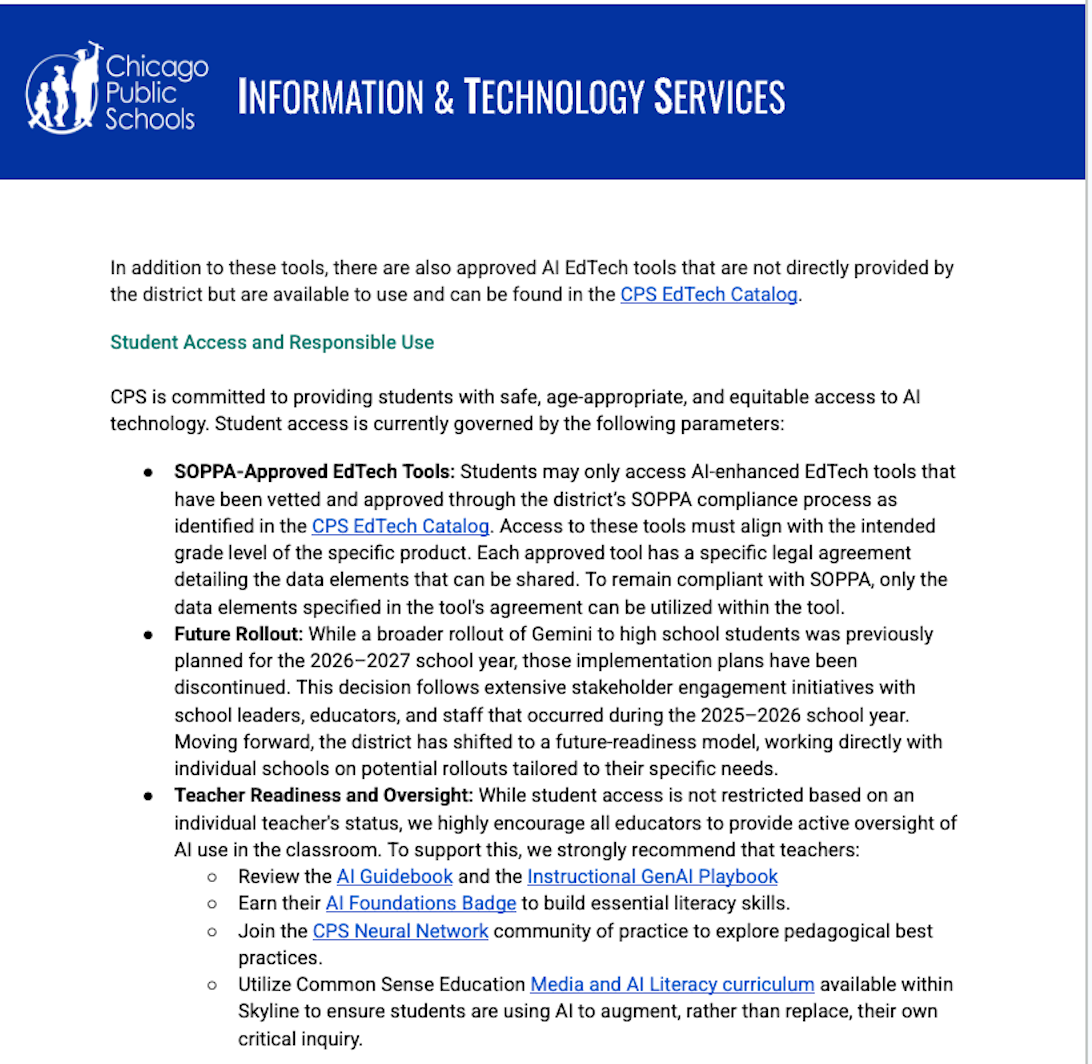
It appears CPS had planned to allow high schoolers to access Gemini. An earlier version of the school district's AI Access Overview (which is undated but, from context, appears to have been published in the middle of the 2025-26 school year), said:
Future Rollout: We are currently conducting a pilot of Gemini access for students, which is strictly limited to high school students at designated "Early Adopter" schools. Following the pilot phase, a broader rollout of Gemini is planned for the start of the 2026-2027 School Year (SY27). At that time, student access to Gemini will remain limited to the high school level for the foreseeable future.
However, on August 4, the parent-led advocacy group Illinois Families for Public Schools sounded the alarm and began encouraging people to write to CPS asking them to stop the rollout. A new version of the AI Access Overview document reads, in part: "While a broader rollout of Gemini to high school students was previously planned for the 2026-27 school year, those implementation plans have been discontinued."
Beyond the campaign to stop the Gemini rollout, IFPS is asking all school board candidates and members to sign a pledge to halt the use of generative AI in CPS for three years, create a Chief Privacy Officer for the school district, set screen time limits for all grades, and prevent the collection of student biometric data. At press time, 21 candidates on the ballot had signed the pledge, including board president candidates Jessica Biggs and Hilario Dominguez.
In a statement, CPS said, "The district is not installing AI chatbots for high school use."
Board Rule reached out to parents, teachers, and students to hear their thoughts on students' use of AI and what school districts should be doing about AI.
A Southwest Side senior who requested anonymity to discuss his AI use said he is generally opposed to AI because data centers have environmental impacts on their surrounding communities. He said he has experimented with AI, but sparingly. "I was in an AP Seminar class, and I used it to brainstorm ideas. I never take what it says at face value. I go to the links it takes its sources from," he said.
This senior strongly supported a moratorium on generative AI in CPS high schools.
A middle school parent who strongly supports AI thought the school district's decision to press pause could make for smarter implementation in the future. But at home, he and his daughter use AI all the time, and discuss the merits and weaknesses of different models, from DeepSeek to Gemini, Claude and ChatGPT. "We talk about what she likes and doesn't like. There is no restriction on how she uses AI" at home, said Thomas Larmena, parent of a seventh-grader in Back of the Yards. "The greatness of AI is that it speeds up your learning. If AI produces a document, you've got to read it. And if you read it, you just might learn something. Amazing!"
At the same time, as a tech entrepreneur, he understands that a school district can't roll out a new tech product without real preparation for teachers. "CPS needs to take a step back. Don't let the technology unit drive the project. We love what we do so much, and we want everybody to use it," he said. "The problem is, it takes time for everybody to understand, especially teachers."
Special education teacher Rebecca Williams, who describes herself as "neurospicy," sees huge potential for generative AI as a tool to promote accessibility and inclusion for students with disabilities. "There are no dumb questions in AI. Students can keep exploring ideas and thoughts" without worrying about how their peers might judge them. "They don't want to ask questions in front of others," she observed. "If we teach them responsible use, limits and boundaries, and what AI can and cannot do, we can mitigate pretty much all the arguments I'm hearing about why we immediately need to put the brakes on."
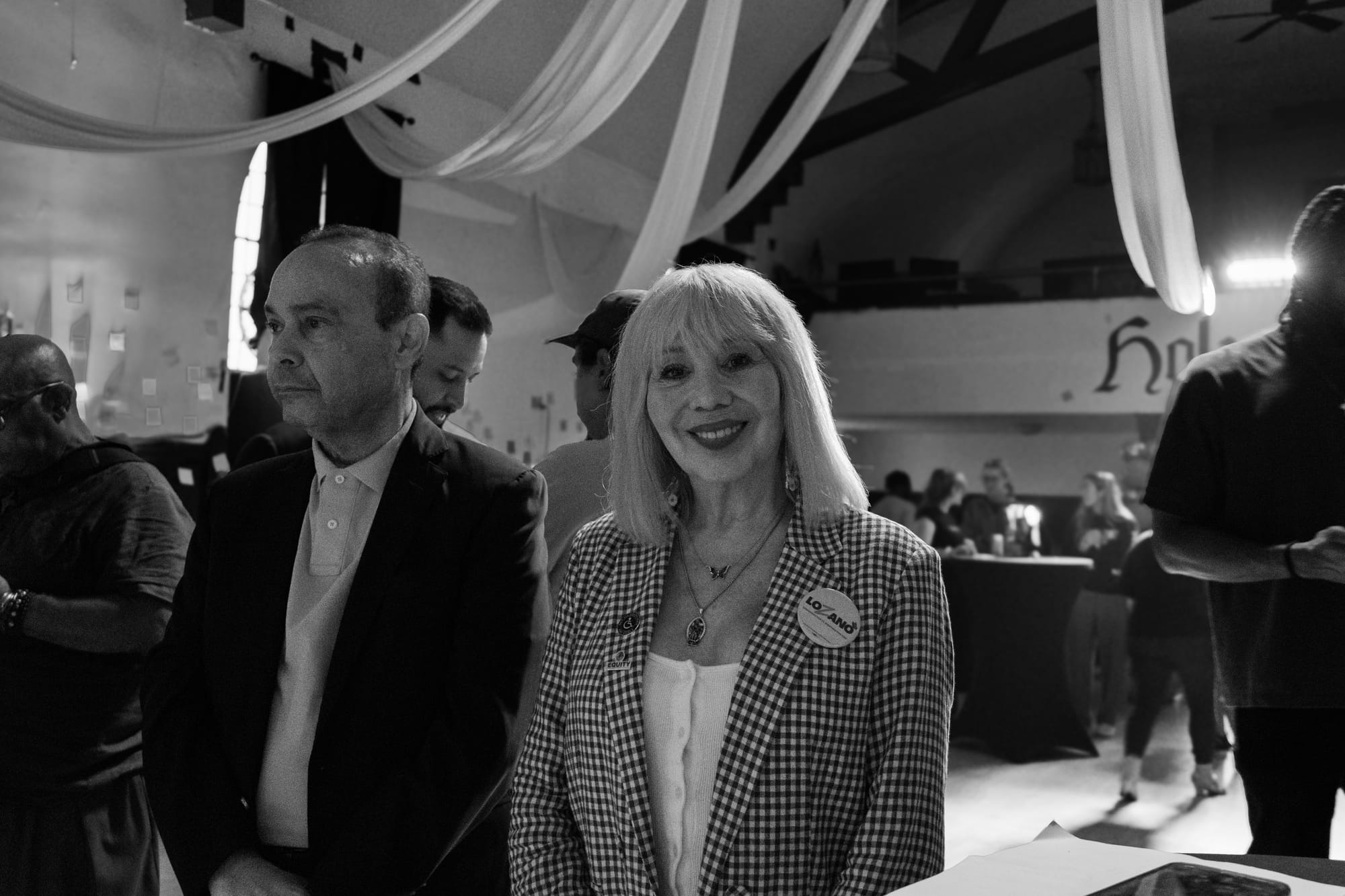
Board Member Profile: Emma Lozano
By Norah D'Cruze
Back in the early 1970s, before Board Member Emma Lozano (7a) became La Pastora, the fiery church leader and activist known nationally for her work to support undocumented immigrants, she was a raven-haired young woman with wide-set eyes driving her own muscle car from Pilsen to her job at St. Anthony’s Hospital in Little Village.
“If I wanted to, I could have roller skated there,” she joked. “I saved all my money for one year, and I bought a brand-new Camaro.”
Lozano has never been afraid to follow her dreams, whether in car purchases or politics. Any chat with her provides a crash course in Chicago’s political and educational history. She brings decades of advocacy for English learners, undocumented immigrants and working-class families to her work on the school board.
The proud Mexican-American daughter of an undocumented union organizer, Lozano learned English “by force,” as a CPS student in the 1960s. She recalled seeing peers who couldn’t adapt to the English-immersion education find themselves left behind, “failed.”
Lozano found her way into organizing thanks to her older brother, Rudy Lozano, who had followed his father into union organizing and later ran a groundbreaking (though unsuccessful) campaign for alderman. After Rudy was murdered in 1983, Emma Lozano chose to carry on his work. In 1987, she ran unsuccessfully for an aldermanic seat in West Town.
In those years, Lozano saw her own children face the same challenges she had as a child: no bilingual education in their overcrowded school, West Town’s Kosciuzko Elementary. Starting in 1988, Lozano led the fight to remake Kosciuzko into a bilingual school with enough space for all the students.
As the Local School Council chair, she worked with fellow parents to stage sit-ins, hunger strikes, and overnight campouts in front of the school board offices. The Rodolfo Lozano Bilingual & International Center Elementary School opened in 1993.
The 1988 creation of Local School Councils opened up opportunities for Chicago’s immigrant parents regardless of their status, Lozano noted. "If you were undocumented, you had no vote in anything. All of a sudden, in the first Local School Council election, you were able to vote and run as a candidate and be a president of a Local School Council."
“When I was an organizer, we were always yelling at the school board members. We were very critical,” Lozano said. Now, as a board member herself, she appreciates serving with other veterans of the tumultuous years of change. “People on the Board of Education now were part of all that struggle, which is good,” she said. “Because [they] have the experience of how we got here, to an elected school board.
To keep her finger on the pulse of what the people want, she said, she tracks public participation at school board meetings and what her neighbors tell her on the street. “I just have to go to El Güero to pick up the milk,” she said, and she gets an earful of comments. “I got this little notebook that I’m constantly writing down everything they’re talking about.”
Priorities. Lozano’s priorities flow naturally from her years of activism:
- Full school funding.
- Representation for immigrant and undocumented parents.
- Protecting immigrant families from ICE and fostering safe schools.
Soundbite. “I’m [in] the no cuts, no closures, no vouchers, no BS group.”
News Roundup
Yesterday, Common Ground Collective announced 18 endorsements in the school board races. The group has not yet endorsed a presidential candidate.
Politico's Illinois Playbook created this list of key endorsements, including the Chicago Teachers Union, SEIU, the International Union of Operating Engineers (IUOE), and Common Ground Collective. Board Rule will be publishing a chart soon and updating it regularly.
Also yesterday, WBEZ reported that CTU is suing the Illinois Policy Institute and the Liberty Justice Center for defamation.
Chicago Magazine, now owned by the Chicago Tribune, recently published an analysis of the stakes in the school board races. (Board Rule Founding Editor Maureen Kelleher is quoted.)
Events
Back to School Resource Fair featuring Carlos Rivas (3b), Thurs. August 20, 1-4 p.m., Lowell Elementary, 3320 W. Hirsch.
School Board Elections Kickoff featuring school board president candidate Jessica Biggs and Carlos Rivas (3b): Sat. August 22, 10:30 a.m. - 2 p.m., Humboldt Park Boat House, 1301 N. Humboldt Dr. Register via QR code here.
The 44th Ward Dems Meet and Greet will be from 5:30-7:30 p.m., on Thurs. August 20, at the Music Box Theatre, 3733 North Southport Avenue. The event will feature the candidates for school board president and for districts 4a and 4b. RSVP.
Jason Dónes (3b): Back in Class Fundraiser, 5:30-7:30 p.m., Mon., August 31, Taqueria La Paz, 5052 W. Armitage. RSVP here.
Board Rule's school board election coverage is sponsored in part by:

Comments ()