The Underdog: Tameka Walton
"People power beats money any time," says the write-in candidate for Chicago School Board District 10A. "I think we forget that.

By Tatiana Walk-Morris
“I’m OK with being an underdog,” Tameka Walton told Board Rule.
That’s good, because she has taken on one of the most difficult campaigns in the 20 school board district races. Walton, a Local School Council member, nonprofit leader, and mother of four, is challenging Grammy-winning songwriter and rapper Che “Rhymefest” Smith for the seat in District 10A.
Though the Chicago Board of Elections ruled enough of Walton’s ballot signatures invalid to prevent her from landing a spot on the ballot, she has campaigned as a write-in “just as hard as I would have” otherwise, she said.
Her determination won her the endorsement of the Chicago Teachers Union, which initially supported her through the grueling ballot challenge process and then endorsed her even as a write-in. That means more money and volunteers than an ordinary write-in candidate would have. But she is still far behind Smith in spending.
As of Sept. 30, the Chicago Teachers Union had paid for $38,249.45 of campaign costs for Walton by Sept. 30. Beyond that, she had at least another $5,500 in the bank at that time, according to state campaign finance records. By contrast, Smith raised $70,920 between the start of the year and 2026. A political organization backed by the Illinois Network of Charter Schools has also spent $78,598 supporting Smith.
“My team, we’re knocking. We’re phone banking. We’re making sure that people know that there is another choice,” Walton said. “We’re having house parties. People are so receptive, right? I think they love an underdog story.”
“Is it possible to win a write-in campaign? Yes,” said Dick Simpson, professor emeritus at the University of Illinois at Chicago and former 44th Ward Alderman. “When they do win, it’s because they’ve got somebody really behind them.”
Still, Walton faces an uphill battle. Generally speaking, it’s rare for write-in candidates to win their races, in part, because they must inform voters about who they are and convince them to write in a name rather than choosing the name on the ballot, Simpson said. Furthermore, her opponent has name recognition working in his favor. “Nine times out of ten, the write-in candidate doesn’t win.”
Ahead of the upcoming election, Board Rule spoke with Walton about her campaign’s progress, the challenges she’s faced while vying for a board seat, and whether she’d run again. During our interview, Walton took a time-out to chase down a voter and hand him some campaign literature. “I know him,” she said. “Our children play soccer.” She sees interactions like these as key steps on her path to victory.
This interview has been edited for length and clarity.
Board Rule: What inspired you to run?
Tameka Walton: The first thing that inspired me to run is [that] I’m a mom. I have 4 children. They have all at some point been through the CPS school system. And so when this opportunity came, I was just like, well, why not? I have the policy experience. I'm also just a current parent in the district, and I feel like my board member is not as accessible as they should be.
You and several other school board candidates were booted from the ballot. Tell me about the challenges when trying to obtain and keep those signatures.
You needed 500 signatures. I got a little over 1,200. I had two challenges on me. They knocked me under by 98 and then 67 of my signatures. Then you have to go back and find people and get affidavits [to confirm they signed the petition]. Mind you, I had to do this… leading up to the 4th of July.
Yes, it’s very discouraging, and it’s not about democracy. It’s not about qualifications, because I’m qualified. It’s about, ‘We only need one name on the ballot.’
You had to go to people’s homes?
With a notary, mind you. [We were] going back to people's houses, literally stalking them.
What advice would you have for candidates looking to run in the future?
I needed 500 [signatures]. I got 1,200. … I was angry. I did everything I needed to do. This is just an unfair process… I would say no, get literally triple the amount and still be prepared to get challenged.
(Walton has accused Smith of being behind the challenges to her ballot signatures. Smith did not respond to Board Rule’s request for comment.)
Despite these challenges, you secured the Chicago Teachers Union endorsement. What support are they offering you?
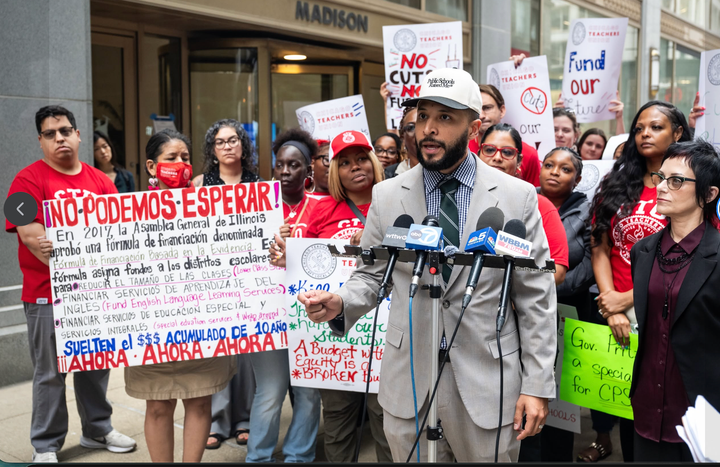
It first started with their being willing to support any candidate that was going through the ballot challenge, right? That was a huge deal… [The CTU is] supporting with bodies for canvassing. They’re supporting with door knocking, with phone banking, literature—all the things that a candidate needs.
Because of the CTU endorsement [and] because of the United Working Families endorsement, I get people. I get so many people every weekend. I get so many people every Tuesday and Thursday that are phone banking. People power beats money anytime. I think we forget that.
If elected, what’s the first thing you want to address?
One of the first things, obviously, [is] the budget… I’m curious about the procurements. I’m curious about the vendors. I’m curious about where our money is going. I’m curious about if they’re doing the jobs that they say they’re doing. I'm curious about looking at those dollars because maybe there are some cuts there that need to be made instead of closing the schools or laying off teachers.
What do you see as your path to victory?
We’re teaching people the write-in process. This is how you write your name in. Because that's important. A lot of people don't understand that that's even an option. We’re taking it very back to the basics and saying, ‘This candidate is running. This is her platform. This is how you write in her name. We’re having house parties. People are so receptive. I think they love an underdog story.
If you don’t win, how would you continue trying to improve the Chicago Public School system?
I'm doing that by being active in my local school, [and] by being a Local School Council member at another school. I'm no longer at that school technically as a parent. I'm a community rep. But then I serve—I'm at another school volunteering where my child is. I'm gonna show up to board members. I'm gonna hold the incumbent, you know, in the case I lose, accountable. But I'm not planning on losing.

Events
Monday, October 26: Public Schools Are a Public Good: Southside Candidate Forum, district 6B and 10A, sponsored by Chicago Black Voter Project, Hyde Park Herald, and South Side Weekly, 5:30-8 p.m., Experimental Station, 6100 S. Blackstone Ave. Register here.
Monday, October 26: School Board 101 Webinar, sponsored by Teach Plus Illinois, the Academy for Local Leadership and the To & Through Project, 5:30 p.m. Virtual. Register here.
Tuesday, October 27: Public Schools Are a Public Good: Westside Candidate Forum, districts 5A and 5B, sponsored by Chicago Black Voter Project, Chicago Votes, Black Bench Chicago, BYP 100, Equity and Transformation, Westside Justice Center, 5:30-7:30 p.m., Douglass Park Ballroom, 1401 S. Sacramento Dr. Register here.
Thursday, November 12: Pathways to Possibility: The State of Higher Education Summit, 9 a.m.-4 p.m., Malcolm X College, 1900 W. Jackson Blvd. Register here.
Wednesday, November 18: IFT Springfield Lobby Day, 9 a.m.-2 p.m., Pasfield House, 525 S Pasfield St., Springfield, IL. Register here.

Comments ()