Alpha School and the Public School That Was Promised
The city's 2001 decision to forego requiring a developer to build a public school in Lakeshore East has had far-reaching consequences.
By Charles Tocci
Alpha School, the new private school using AI tutors, has arrived in Chicago. While its hefty price tag and bold claims about accelerated learning have driven national media attention, it’s the school’s location that reveals an important lesson about education in our city.
The $ 55,000-a-year private school sits on land the City Council designated for a public school almost 60 years ago, a historical twist that shows us what happens when our system relies less on public schools and more on private choices.
Located at 350 East South Water Street in Lakeshore East, Alpha School's building covers a portion of the land City Council rezoned in 1969 as part of its plan to create “Chicago Planned Development No. 70,” a residential neighborhood. As part of the agreement, the developer had to include “a public school…north of and fronting a public park.” In 1979 and 1993, the city reaffirmed its commitment to a public school in the development.
But development did not move quickly. While a succession of companies took the mantle of lead developer, none made progress, and from 1994 to 2001, a 9-hole golf course occupied the site.
In 1988, the Magellan Development Group started negotiations with City Hall over the area. By 2000, City Council had passed an ordinance with a much more specific requirement for a public school, saying “the applicant shall be responsible for the construction of a…fifty-three thousand (53,000) square foot structure to contain a public elementary school with space to be shared with the Chicago Park District.”
Two years later, the city authorized $58.9 million in municipal bonds to help pay for Lakeshore East infrastructure and upped the size of the school to 60,000 square feet.
But even as new homeowners moved in, no school was forthcoming. By 2009, Magellan was offering to reserve space for a private school in the soon-to-open Aqua Tower instead. It took a FOIA from a Lakeshore East resident, Richard Ward, to learn more about how Magellan was able to avoid building a public school in Lakeshore East.
Ward’s public records request revealed that in October 2001, the city’s Department of Planning and Development sent a letter absolving Smith Properties from having to contribute to “Public Park, Public Elementary School or other public improvements.” Smith was a Delaware-based limited liability corporation purchasing the undeveloped lots in Lakeshore East. Now, the developer was off the hook for building a new school and responsibility for repaying the development bonds fell to buyers moving into the new neighborhood.
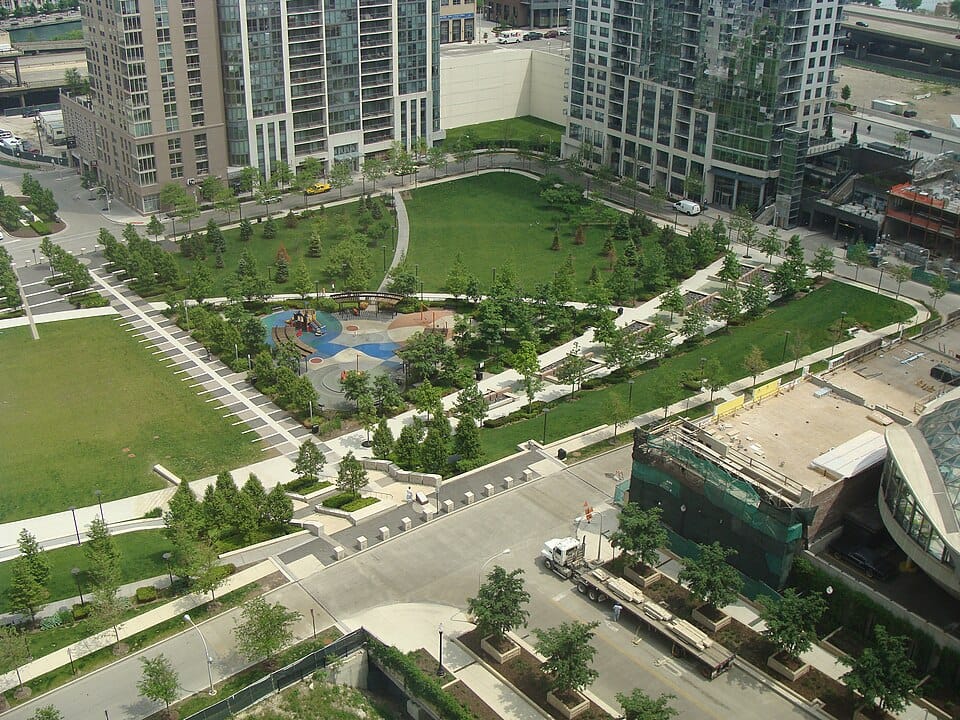

In the meantime, the neighborhoods from the South Loop up through the Gold Coast were increasingly popular with white families, and their CPS neighborhood schools were filling past capacity. Building residential towers but not a school in Lakeshore East helped fuel that overcrowding, which played out in the high-profile cases of the Ogden-Jenner merger and the attempt to expand South Loop Elementary while creating a neighborhood high school for South Loop families.
In 2011, Ogden International moved into a brand-new K-8 campus at 24 West Walton. When that building was quickly over-enrolled, the district brought the majority-Black and under-enrolled Jenner Elementary into Ogden as a middle grades campus. This move generated a great deal of controversy across both schools’ communities.
Similarly, South Loop elementary’s student body surged in size. A complicated plan to expand that school while turning the majority-Black National Teachers Academy into a high school was stopped by community protests and a district judge in 2018.
Back in Lakeshore East, a school finally opened in 2014. GEMS World Academy, an international chain of private schools based in Dubai, made Chicago home to its first US school. The K-4 building opened first at 350 East South Water Street with a $32,000 a year tuition, and they broke ground on a 5-12 school at neighboring 355 East Wacker Drive in 2018. But enrollments never grew enough to support the school, and with just over 200 students in 2024, plans to open the upper school were abandoned in 2019. The uncompleted building was surrendered to lien holders in 2014. GEMS put the lower school up for sale in February 2025 and closed it in June.
That August, the upper school building was purchased by a developer with plans to open a Jewish college prep high school in 2027. Alpha School announced its move into the lower school in spring of 2026 and opened its doors earlier this month.
Alpha School may or may not succeed in Chicago, but the land beneath it will always hold the story about a public school that was promised. That promise was not to offer one more option in a marketplace of public, charter, and private schools. It was to build a school to serve its neighborhood.
Charles Tocci is an associate professor of education at Loyola University Chicago and a Chicago Public Schools parent.
Giving Thanks to You, Readers!
Last week, Board Rule hit an important milestone: 1000 subscribers. That means you, dear reader, are part of a 1000-member community of civic-minded Chicagoans. All of you share a passion for supporting public education that gives the city's young people the tools they'll need in the future.
Thanks to you, Board Rule was able to win a $40,000 Press Forward Chicago grant to cover the historic school board elections, with a focus on South and Southwest Side races. We partnered with Chalkbeat Chicago to cover ballot challenges, went deep into candidate forums, and followed the money. We are deeply grateful to Press Forward for making it possible to do so much with our election coverage. And, as grants do, that grant ended.
Now, it's time for Board Rule to help you learn like a board member. Between now and mid-January, when the elected board is seated, we'll be briefing you on key issues, from expanding universal preK to 3-year-olds, to the real deal on what school closures do and don't do, to what we know is working to help Chicago kids learn and thrive. Board Rule is committed to making information free and easy to understand. We hate paywalls as much as you do, but we used one for our voter guide, and it worked. Nine of you became paid subscribers just to get our guide. Thank you!
Right now, 79 of you are paid subscribers at any level. This is a great number, and you are the kind of committed audience that can do even better. Board Rule would be even stronger with 10% of our audience paying for a subscription. So 11 free readers are encouraged to upgrade to a paid subscription. Could one of them be you?
More paying subscribers would help demostrate the viability and sustainability of Board Rule. That would put us in a solid position to pursue more funding opportunities, including more project grants managed through our fiscal sponsor, Public Democracy America.
Don't forget, we have two paid tiers: the Junior Board level for sustainers at $5/month or $50/year, and the Parent/Community/LSC member tier at just $10/year. Some subscribers are able to get their subscriptions reimbursed by their employers, and Board Rule is eager to offer discounted group subscriptions. Please reach out to maureen.boardrule@gmail.com to learn more about group subscriptions.
And if you'd like to make a one-time gift to help sustain the work, stop by our tip jar. (Note, Board Rule is not a 501(c)3, so individual contributions are not tax-deductible.)
Wishing all of you a very happy Thanksgiving.
Comments ()