How CPS Spends Its Money
Chicago Public Schools says the biggest drivers of its budget gap are higher costs for personnel, aging buildings, and longstanding debt.
The Chicago Public Schools, like school systems worldwide, spends big on people. People who teach. People who assist teachers or work with students receiving special education services. People who lead schools. People who keep everything humming from the main office front desk. People who serve food, walk hallways, drive buses, and clean school buildings.
Schools run on people, and people cost money. Their wages, salaries and benefits cost money now, and their pensions will continue to cost money in the future. Even as enrollment declines, an increasing share of the remaining students need people with harder-to-find expertise, especially bilingual teachers and special educators trained to support students with an Individualized Education Program (IEP).
At last night’s West Side budget roundtable, held at Westinghouse College Prep, CPS officials used this image to show its three major expenses: people, debt, and buildings. (You can view the full decks online in English and Spanish.)
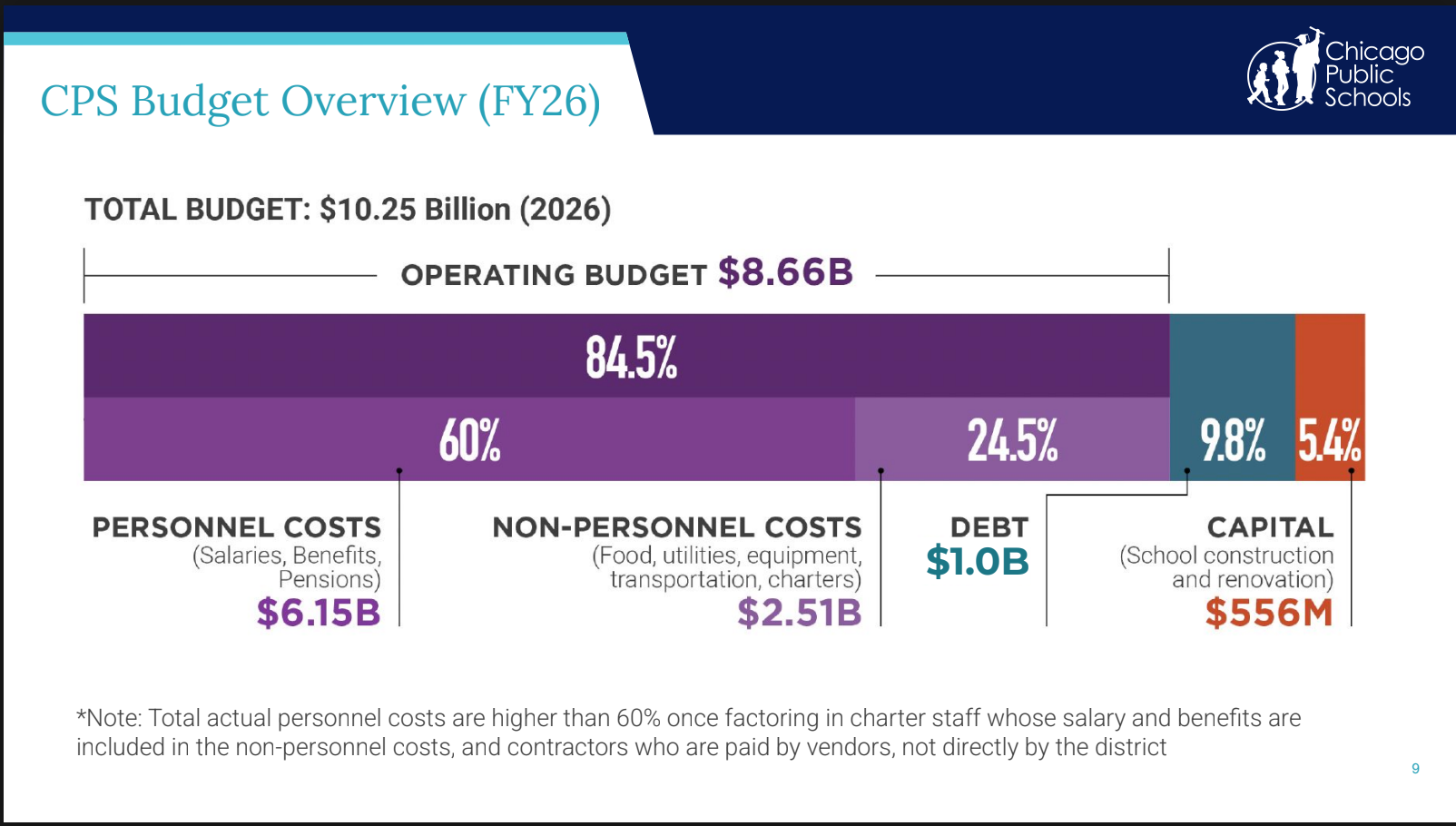
This slide from the CPS budget roundtable presentation actually undercounts the amount of money spent on people, because people are included in the “non-personnel costs.” For example, charter schools are included in “non-personnel,” because the people aren’t paid directly by CPS, but most of the money in charter school budgets, like money spent by their CPS-managed counterparts, goes to people. The same goes for vendor contracts, many of which pay for people: from lawyers to curriculum developers to bus drivers.
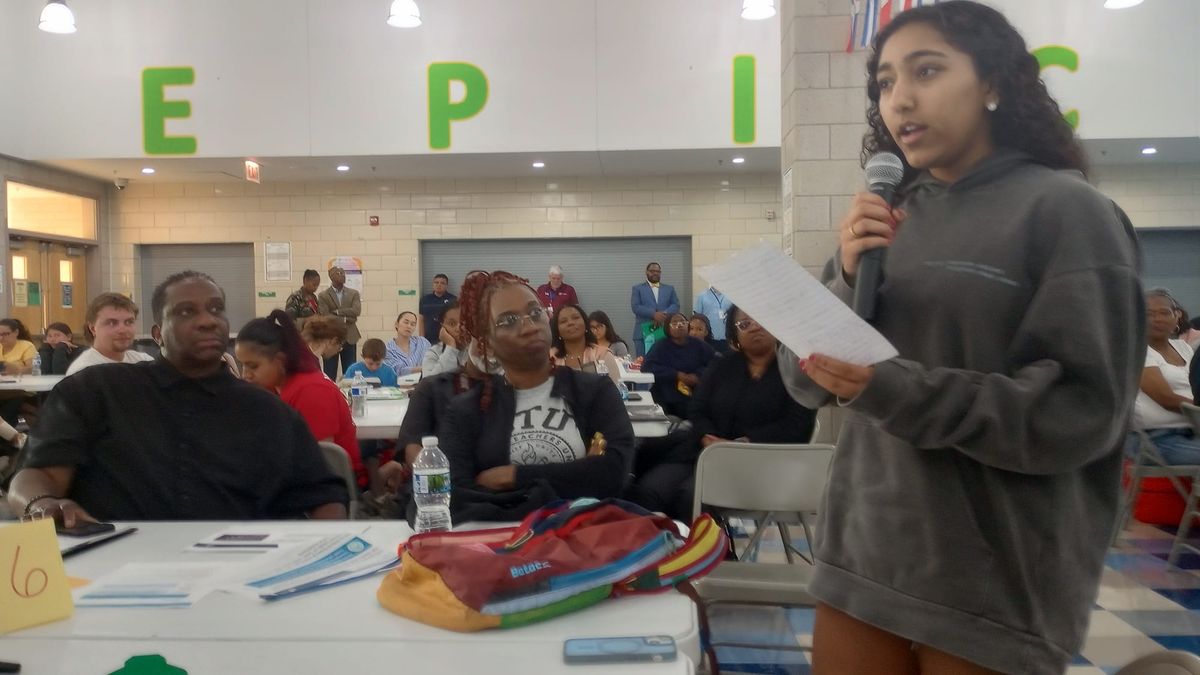
Recent changes in custodial staffing illustrate the challenges of cutting back on people. Fewer custodians can save money, but they may not be able to handle all of the work. At last night’s roundtable, CPS students observed that their schools are dirtier since custodians were cut.
This becomes even more complex when cuts threaten teachers and school leaders. For example, Payton student Akshara Rajan told the Westinghouse attendees that her Latin teacher’s job had been cut from full-time to part-time. This may sound minor in the big picture, but for dozens of high schoolers it means no first-year Latin, and for about 100 students who want to complete four years of Latin, it means joining a lesser, online program that costs $700 per pupil. (The Chicago Tribune has also covered the situation.)
Payton parents are trying to develop a fundraising program just to cover this expense. Rajan also told the crowd that “equitable funding” is needed to ensure schools with less wealth to draw from can keep their programs, too.
What’s Driving the Budget Gap?
According to CPS, three things: costs to educate students with IEPs are rising without corresponding increases in state and federal funds; facility and personnel costs, including pensions, are rising; and CPS is carrying a lot of debt.
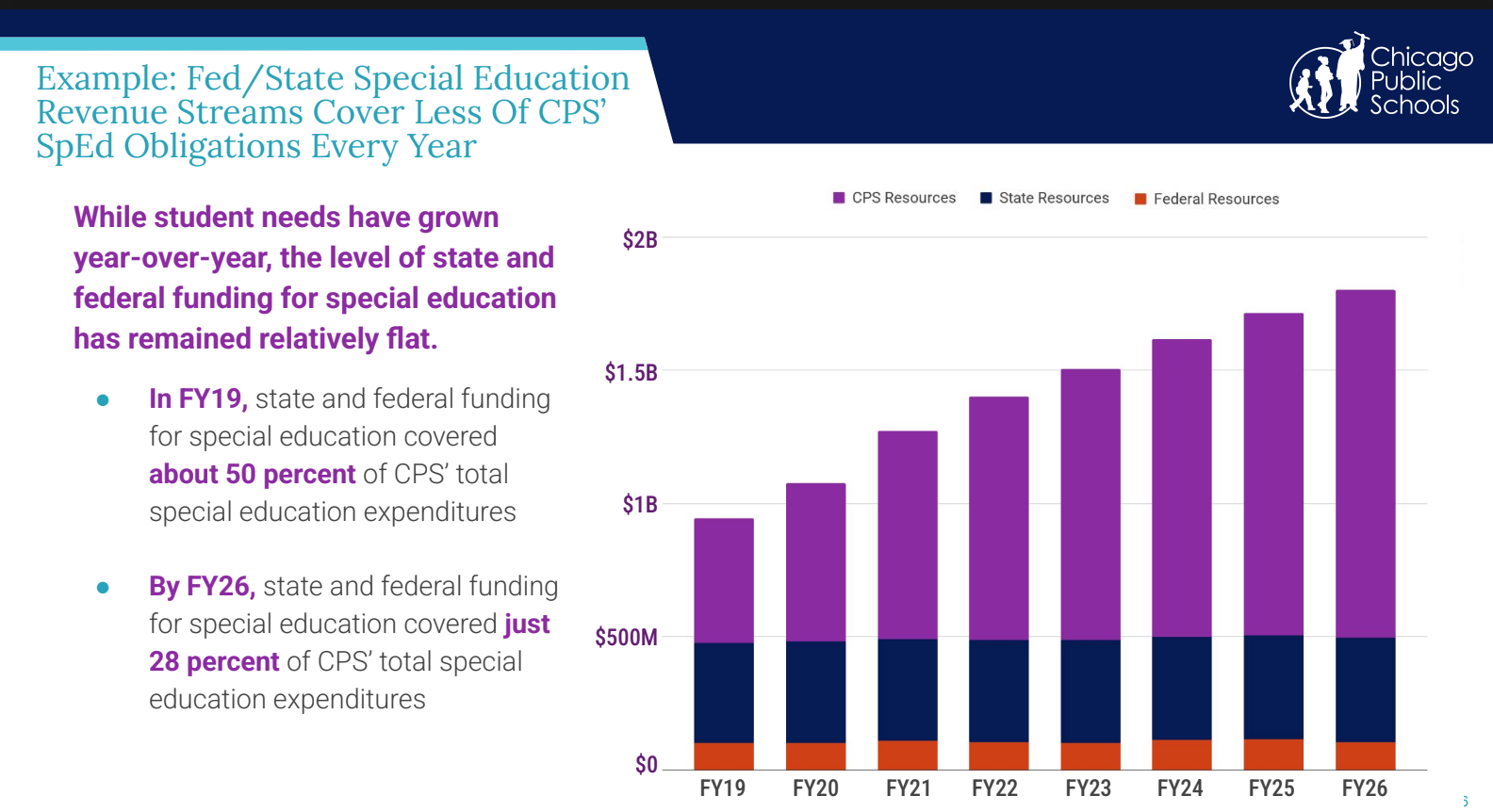
The roundtable deck provides a clear chart showing how special education expenses have grown though state and federal funding have not, leaving CPS to pick up more and more of the tab. At the same time, this year CPS officials were very careful to note that this expense is part of their mission: to educate all students. Last year parents chastised the school district for making it sound like children with IEPs were the problem.
As for the pension costs; although various actors, including CPS, have proposed merging the Chicago Teachers Pension Fund with the Illinois Teachers Retirement System to cut costs, it remains a political nonstarter.
Many people attending the event were surprised by the amount of debt CPS now carries. The school district carries more than $9 billion in long-term debt that now requires over $900 million annually in payments. About $700 million of the money for those payments comes from property taxes, which could have been spent on meeting current classroom needs. The recent IT issues plaguing Cook County’s property tax collection system aren’t helping any. For many years, CPS has regularly borrowed against property taxes because the money doesn’t arrive in time to meet big annual bills. The IT-related delays in collecting property taxes have made this longstanding situation worse, forcing CPS to pay even more money in interest.
At last night’s roundtable, proposed strategies to close the budget gap ranged from organizing with school districts around the state to press for an increase in state school funding during a special summer legislative session to controlling cost overruns on building projects.
CPS has scheduled five more roundtables in the coming weeks. You can RSVP here.
- June 27, 10 a.m.-12 p.m., Back of the Yards College Preparatory High School, 2111 W. 47th St. (Spanish Presentation)
- June 30, 5:30-7:30 p.m., Walter Henri Dyett High School For The Arts, 555 E. 51st St.
- July 1, 5:30 p.m.-7:30 p.m. (Virtual)
- July 7, 5:30-7:30 p.m., Theodore Roosevelt High School, 3436 W. Wilson Ave.
- July 13, 5:30-7:30 p.m., Gwendolyn Brooks College Preparatory Academy, 250 E. 111th St.
Board Rule News
With support from Press Forward Chicago and the Medill School of Journalism at Northwestern University, Board Rule is growing!
Board Rule is delighted to announce we are one of 15 media organizations receiving grants through Press Forward Chicago. Board Rule has been awarded $40,000 to cover the school board president’s race and select races on Chicago South and Southwest Sides. Thanks to the grant, we’ll be bringing in contract editor Erika Hobbs and noted freelancer Jewél Jackson to help with coverage.
With support from Medill’s Local News Initiative, Board Rule is working with fellows Norah D’Cruze and Maggie Xiaotang Meng. Norah will be talking with folks in South and Southwest Side communities to learn what’s on their minds as we head into the election. Maggie will be leading the charge to make the most of our news and information through more sophisticated web and newsletter design and by experimenting with our social media platforms.
This summer, Board Rule will also benefit from the reporting skills of Isaiah Pinzino, a rising junior at the University of Missouri. Isaiah is digging in on petition challenges.
Board Rule will continue its partnership with Adam Parrott-Sheffer to produce the school board report card. Full disclosure: Parrott-Sheffer is one of two objectors to signatures on candidate Victor Henderson’s campaign petitions. (Of note; Henderson is not a current school board member.)
Parrott-Sheffer has been collaborating with Board Rule the report card for over a year, and we have received assurances that his ballot challenge will not color his analysis of school board meetings. Board Rule’s new reporting team will be working closely with Parrott-Sheffer on the report card and will provide a fresh set of eyes on how transcripts are coded.
Comments ()