Charter Renewals Top Today's Chicago School Board Agenda
Expect a floor fight today as the Chicago Board of Education votes on charter renewals. But tinkering with terms doesn't equal real stewardship.
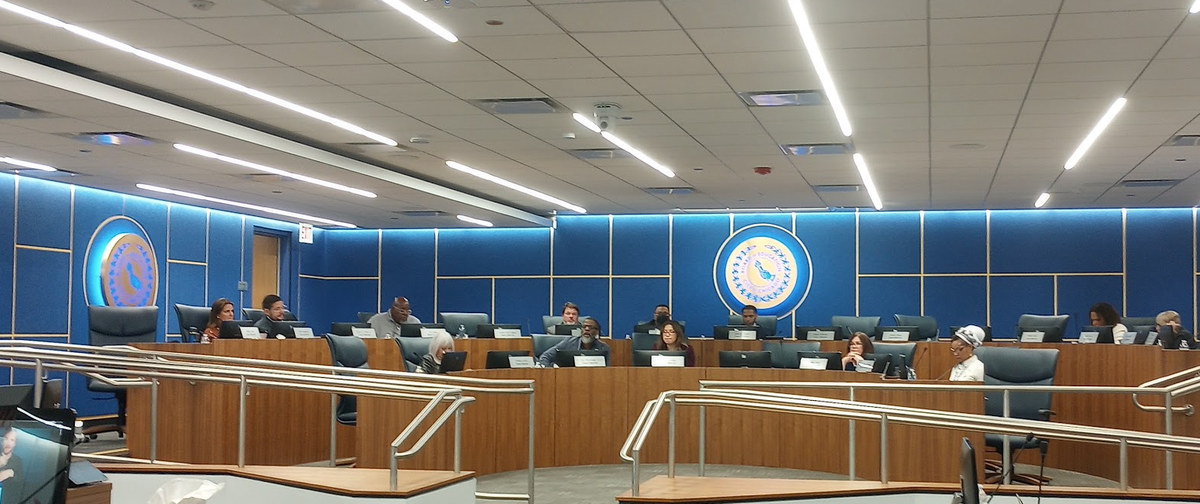
Today’s board meeting boasts a jam-packed agenda. The board will vote on a resolution to support changes to the state tax structure to create “progressive revenue,” taxes that take more money from wealthier people and entities than from those with less. They will also decide on the hiring of inside lawyers and outside legal firms, and employee dismissals. Three policies are expected to move forward for public comment. And there are plenty of contracts to be voted on.
But it’s unlikely any items will spark more controversy than the charter renewals up for board approval.
The renewal debate. Last year, Chicago Public Schools recommended 2-year renewal terms for 10 of 16 charter schools, a move that sparked consternation among charter operators. This year, the district is reviewing half as many charter schools, and some are among Chicago’s longest-running charters.
For months, charter leaders, teachers, and parents have been speaking at school board meetings, urging longer renewals. They assert that short renewals create overwhelming administrative burdens on schools, especially at single-site charters with fewer back-office staff. That takes time away from improving teaching and learning. Short renewals can also make it harder for charter schools to prove they will be around long enough to be creditworthy, as discussed in last week’s newsletter.
Meanwhile, the Chicago Teachers Union and allied board members argue that shorter renewal terms provide stricter oversight and could prevent problems like the mid-year closure of ASPIRA Charter or the end of EPIC Academy, which received a 2-year renewal last May, and then announced in August it would close at the end of this school year.
“If the past two years of charter companies crashing out and running away with real estate have taught us anything, it's that they need more oversight to guarantee stability for students and the existence of financial standards that are in place at basically any other entity,” CTU chief of staff Matthew Luskin said in an emailed statement.
The school board has had continuing discussions with the CPS Office of Innovation and Incubation, which oversees charter schools, about the rubrics it uses to determine renewal terms. Board member Karen Zaccor (4A) took the lead on this from the board side, asking herself: “How could I & I get in front of these problems? The old rubric wasn’t working – it would have given Acero a longer term.”
We are likely to see the current version of those rubrics in today’s presentation of charter renewals.
This year’s renewals. This year, the proposed renewals are longer: The minimum is four years. Andrew Broy, executive director of the Illinois Network of Charter Schools, sees that as reasonable. “What we really disagree with are 2- and 3-year terms that put the charter schools on a treadmill instead of getting better,” he said.
Today’s agenda not only spells out renewal terms for each charter, but spells out specific conditions that must be addressed. The conditions range from clearly compliance-oriented to clearly student-focused. Clear compliance conditions include keeping track of teachers' licensure in a state database to hit the legal requirement that 75% of charter teachers are certified. A clearly student-focused condition calls for teachers to receive training on discipline with the goal of reducing suspensions.
Some requirements related to special education and English learners may occupy a gray area. “Compliance is not performance,” noted Broy. “I’m less concerned whether the special education office has the 3-ring binders than whether the special education students are showing academic growth.”
All of this year’s charters are being told to remove executive leadership staff from their boards, a move that is likely intended to reduce conflicts of interest, but deviates from standard practice in many nonprofit boards, where the executive director is a member.
Here are the renewal terms and conditions CPS is proposing:
Expect a floor fight. Or, at least, tinkering with the terms. The 5-year term for Acero Schools is likely to cause the most controversy. The charter operator drew fire in 2024 after it announced it would close seven campuses, half of its network. That December, the lame-duck, six-member appointed school board voted to keep five of the campuses open and transition them into the school district. Charter parents and CTU organizers have kept the pressure on Acero through the transition, and board members who view short renewals as a way to enhance oversight may well suggest Acero needs a shorter leash.
An alternate approach: longer renewals plus midterm reviews. Across the country, renewal terms range from two to 20 years. Arizona, perhaps the most permissive state in the country, allows the 20-year renewals. “I actually think that’s too much,” said Broy. “You can’t have a student go from K through 12 without a school being renewed.”
But in Washington, D.C., where charters educate nearly half the city’s public school students and are governed by their own school board, charter schools routinely receive 15-year contracts. The long contract is coupled with 5-year evaluations of academics, finances and operations. Based on those evaluations, the DC Public Charter School Board can choose to continue the contract with or without conditions, or start the process to revoke the charter.
Back in Chicago, both pro- and anti-charter board members agree that better oversight takes more than adjusting the length of renewal terms. “There’s things they should be able to do” beyond shortening renewal terms, said board member Angel Gutierrez (8A), such as basics like checking they are in good standing as nonprofits with the Illinois Attorney General.
Board member Debby Pope (2B) told Board Rule that board members have been advocating for “midpoint evaluations, rather than you get a good renewal or you don’t get a good renewal.”
Broy noted that Illinois charter law already allows authorizers to do mid-term reviews, a practice CPS engaged in regularly during Mayor Rahm Emanuel’s tenure.
More effective CPS oversight could somewhat reduce tensions over renewals. However, since the current school board took office, annual renewals have become a flashpoint for ideological battles over whether charters should be able to operate differently from district-managed schools when it comes to staffing, pay, and union representation, and even whether charters should exist at all.
It’s that ideological battling that bothers Gutierrez. “Whether you hate charters or not, they’re a part of our system.”
Note: Youth Connection Charter School, an umbrella charter that supports 17 mostly community-based alternative schools across Chicago, is also up for renewal, but its situation is unique. Board Rule will tackle it in detail in an update tomorrow, when we report the outcome of today's charter renewal votes.
Commentary: An Experiment
For the summer, Board Rule is inviting brief commentary on issues before the Chicago Board of Education, as well as broader issues facing the Chicago Public Schools. Here are our submission guidelines:
Keep it brief: 400 words, plus suggested headline and author bio.
Keep it relevant: Topics should be focused on Chicago’s school board and school district.
Ground opinion in facts: Board Rule appreciates links to evidence for your opinions.
Parent and community voices first: Board Rule will prioritize commentary from those closest to the schools and neighborhoods farthest from opportunity.
Please submit commentary, ideally as a Google Doc, to maureen.boardrule@gmail.com. If you have not received a response within one week, that means Board Rule will be unable to publish your commentary. Board Rule will not publish commentary during the height of campaign season, between August 15 and November 15.
With that, here’s our inaugural op-ed, from Hibbard Elementary parent Maggie Cullerton Hooper.

Immigration enforcement is not a solution to overcrowding
Last fall, I sat in my local ward office sorting Halloween candy bags for the 800-plus Albany Park children using walking school bus programs. We wanted every student to celebrate the holiday with some sense of normalcy amid the months-long campaign of state-sanctioned terror.
Suddenly, the sharp shrill of whistles sent everyone racing outside. Our alderwoman, her staff, and ordinary neighbors were immediately faced with yet another ICE confrontation — pepper balls shot at us, chemical weapons deployed, all while being physically and verbally assaulted. In the end, two young men were ripped away from our community.
Less than month later, the Chicago Public Schools Office of Portfolio Management sent a memo to CEO Macquline King recommending she deny Haugan Elementary’s application for co-location to the building at 3729 W. Leland Avenue. Though the memo noted that more local families were choosing Haugan, and that the school was shuffling schedules to try to make the space work, it also projected the school wouldn’t keep growing.
In a chilling aside, the memo read, “recent actions from the federal government may impact future growth within the community, which has a high percentage of Latino and immigrant families.”
Our community continues to feel the devastation wrought by ICE in the absence of our neighbors, in the faces of children whose parents are still being illegally detained, in the empty sidewalk where a grandmother sold our morning coffee. The shock of the violence has left us reeling.
But to some in CPS, it appears to be a remedy for overcrowding.
At Haugan, children with disabilities learn in storage closets. Kids seeking mental health support meet with school counselors in hallways, under stairs, and in bathrooms. CPS could fix this.
Less than a block from Haugan, in the CPS-owned building at 3729 W. Leland Avenue, North River Elementary School welcomes students to the first and second floors. The entire third floor, once home to the now-closed ASPIRA Haugan Middle School, sits vacant.
The same broad authority that allows CPS to secure modular classrooms (trailers) and lease spaces to address overcrowding, allows them to grant temporary, limited use of the vacant school. But it appears district leaders would prefer to wait and hope that the violence of the federal government will reduce enrollment at a neighborhood school.
Today, Thursday, May 28, at the Chicago Board of Education meeting, we will submit a community letter, a Haugan parent letter, and offer public comment to demand that CPS use their authority to grant Haugan temporary use of the vacant space next school year.
Maggie Cullerton Hooper is a Local School Council member at Hibbard Elementary, a trained rapid responder with NWS Defense, and formerly served as a deputy commissioner at DCASE and the chief philanthropy & partnerships officer for the City of Chicago. She ran unsuccessfully for the Chicago Board of Education in 2024.
Comments ()